
EinScan Rigil
4.9Editor score
Wireless all-in-one design
Hybrid blue laser and IR
Onboard computing with 1TB SSD
This guide compares the top 3D scanners for reverse engineering, evaluating precision, speed, and software compatibility to help you choose the right industrial
Reverse engineering requires precise digital capture of physical objects to recreate or improve designs. A high-quality 3D scanner is essential for engineers, designers, and manufacturers who need accurate geometry and texture data for CAD modeling and inspection workflows.
We evaluated ten leading handheld and structured light scanners based on accuracy, scanning speed, software integration, and ease of use. Our analysis focuses on devices capable of handling complex surfaces, dark materials, and large objects without extensive preparation or spraying.
Each product in this list offers unique strengths for industrial applications ranging from automotive prototyping to heritage preservation. Note that pricing and availability may vary over time, so verify current details before making a purchasing decision for your specific project needs.
4.9Editor score

4.8Editor score

4.6Editor score
This table provides a side-by-side comparison of the ten selected 3D scanners, highlighting their core specifications, scanning modes, and key capabilities to help you quickly identify the best fit for your reverse engineering tasks.



The Revopoint MetroX Pro stands out as a top-tier device for reverse engineering due to its industrial-grade blue laser technology. It captures intricate details with single-frame precision up to 0.01 mm, making it ideal for precision modeling and quality inspection.
We may earn a commission when you buy through this link, at no additional cost to you.
Its four scanning modes offer flexibility for different object sizes and surface types. The ability to scan shiny or dark surfaces without spray saves significant prep time and keeps delicate parts clean during the digitization process.
While the software is intuitive, advanced CAD export requires paid tools which can add to the total cost. This trade-off is acceptable given the high accuracy and workflow efficiency it provides for professional environments.
Professionals needing reliable data for CAD reconstruction should choose this scanner. It balances performance and usability effectively, ensuring your digital assets are ready for manufacturing or further design work.
The blue laser ensures high contrast even on challenging materials, reducing the need for markers or powders during the scanning session.
Seamless transfer to Revo Measure or other 3D software allows engineers to move quickly from raw scan to finalized design.
We may earn a commission when you buy through this link, at no additional cost to you.
The Revopoint MetroY Ultra is engineered for speed without sacrificing accuracy. It delivers up to 90 FPS with an NVIDIA GPU, significantly reducing the time needed to capture medium to large industrial parts.
We may earn a commission when you buy through this link, at no additional cost to you.
Wireless freedom via Wi-Fi 6 allows operators to move around large objects without cable drag. This feature is crucial for scanning bulky items like engine blocks or vehicle components in a workshop environment.
The included battery grip extends field work capabilities, but heavy usage can still drain power quickly. Users should plan for charging cycles during extended sessions to avoid interruption.
For teams prioritizing throughput and mobility, this model offers an excellent balance. It ensures that high-volume reverse engineering tasks are completed efficiently while maintaining metrology-grade precision.
The high frame rate reduces motion blur and improves the fidelity of the point cloud even when scanning complex moving parts.
Built-in battery and wireless capabilities make this scanner suitable for on-site inspections without needing a stationary power source.
We may earn a commission when you buy through this link, at no additional cost to you.
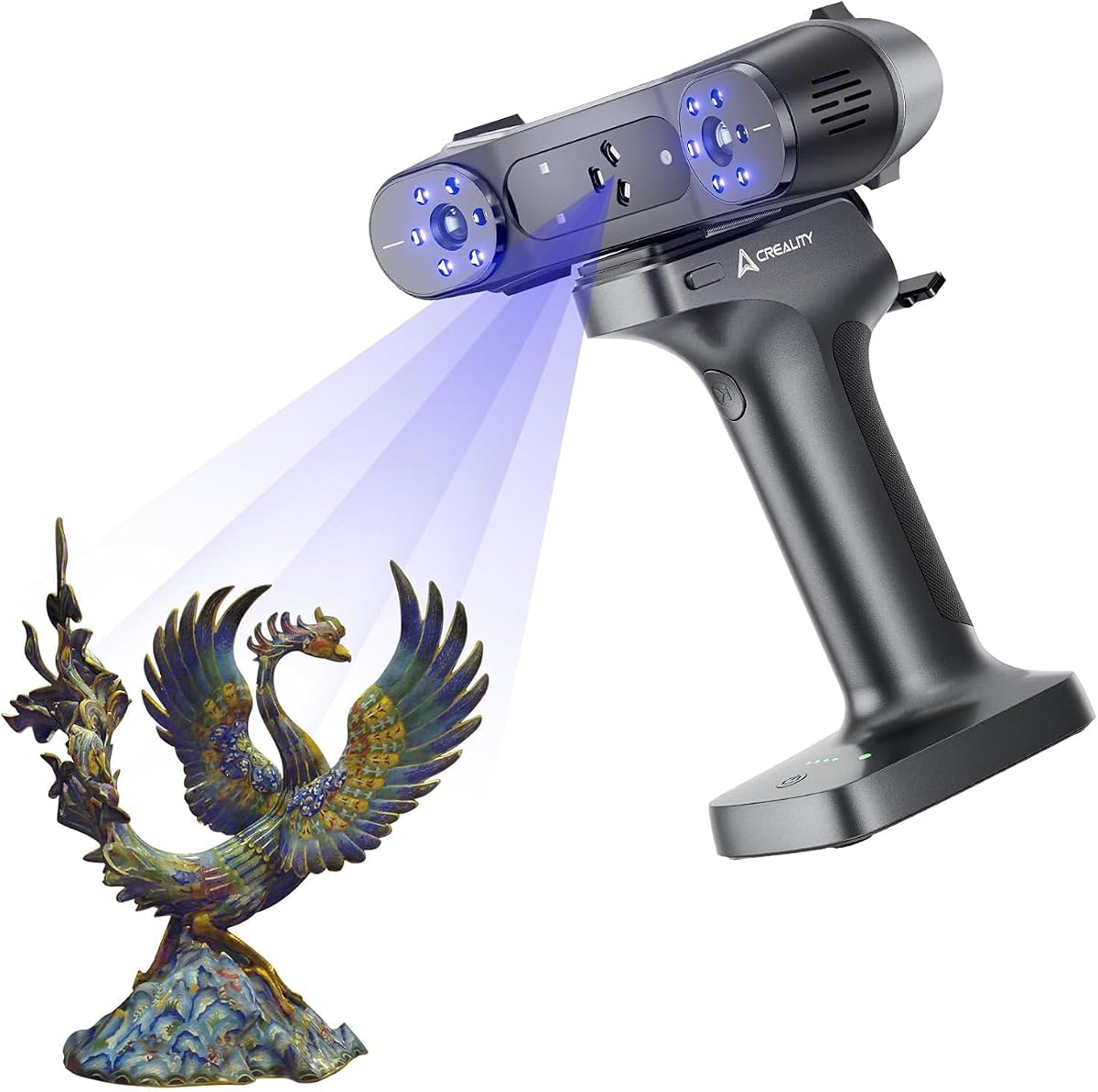
The EinScan Rigil redefines portability with its all-in-one wireless design. It runs on onboard computing hardware, eliminating the need for a laptop during the actual scanning process, which streamlines field operations significantly.
We may earn a commission when you buy through this link, at no additional cost to you.
Its hybrid light source combines blue laser and IR VCSEL to capture dark or reflective surfaces with high fidelity. This makes it ideal for automotive and engineering applications where surface conditions vary widely.
The device is expensive compared to competitors, but the included training and comprehensive package justify the cost for professional firms. It removes technical barriers and ensures rapid adoption across the team.
If you need a standalone tool for complex reverse engineering without tethering to a computer, the Rigil is unmatched. It delivers consistent performance in diverse environments from the studio to the factory floor.
Onboard processing means you can review and adjust scans immediately without connecting to external devices or software.
Designed to function under bright sunlight, it expands the range of environments where precise data capture is possible.
We may earn a commission when you buy through this link, at no additional cost to you.
The Creality CR-Scan Raptor Pro is built for handling large-scale projects like automotive bodies or industrial machinery. It supports scanning from 5mm up to 4000mm, making it versatile for both small components and whole vehicles.
We may earn a commission when you buy through this link, at no additional cost to you.
Its dual blue laser configuration ensures rapid data acquisition with 660,000 dots per second. This speed is critical for reverse engineering tasks where minimizing downtime and maximizing output is a priority.
While powerful, the software demands decent hardware specifications for smooth operation. Users should ensure their workstation meets the recommended config to avoid lag during post-processing and alignment.
For organizations needing to digitize large assets accurately, this scanner is a strong choice. It bridges the gap between consumer and industrial tools with impressive performance at a mid-range price point.
The wide field of view allows capturing big objects in fewer passes, improving efficiency for large part reverse engineering.
24-bit full-color scans provide realistic textures that are useful for visual inspection and presentation models.
We may earn a commission when you buy through this link, at no additional cost to you.
The Revopoint INSPIRE 2 brings professional scanning capabilities to a budget-friendly tier. Weighing only 190g, it is one of the lightest options available, reducing fatigue during extended handheld scanning sessions.
We may earn a commission when you buy through this link, at no additional cost to you.
Its infrared laser lines allow for scanning reflective surfaces without spray. While not as fast as blue laser models, it offers sufficient accuracy for general reverse engineering and prototyping workflows.
The optical zoom feature helps capture fine details on mixed-geometry surfaces that might otherwise be missed. However, the overall point density is lower than top-tier industrial scanners which may limit high-precision needs.
Small businesses or hobbyists starting with reverse engineering will find this model highly practical. It delivers reliable results for 3D printing and design iterations without a heavy financial commitment.
Its lightweight build makes it easy to carry for field work or moving between different workstations in a lab.
Designed to work in shaded outdoor environments, it enables data collection outside controlled lighting conditions.
We may earn a commission when you buy through this link, at no additional cost to you.
The Creality Otter Lite Basic is designed for simplicity and ease of use. It offers two scanning modes for close-range and long-range capture, making it adaptable for small parts or moderate-sized items in a workshop.
We may earn a commission when you buy through this link, at no additional cost to you.
With a resolution of 0.05mm, it captures enough detail for most hobbyist reverse engineering projects. The inclusion of full-color texture mapping adds visual realism to the digital models created during the process.
While powerful, its range is limited compared to industrial devices. Users focusing on tiny components will appreciate the precision, but those needing large object scanning may find it restrictive for certain tasks.
For DIYers or educational settings, this scanner provides an accessible entry point. It minimizes complexity while delivering useful 3D data for printing or design modifications without requiring expert skills.
Intuitive controls and visual feedback guide users through the process, reducing the learning curve for new operators.
Included accessories like turntables and markers ensure you have everything needed to start scanning immediately.
We may earn a commission when you buy through this link, at no additional cost to you.
The Revopoint MetroX Pro provides a balanced solution for users needing high precision without the cost of ultra-premium tools. Its single-frame precision of up to 0.01 mm ensures that dimensions are captured accurately for reverse engineering tasks.
We may earn a commission when you buy through this link, at no additional cost to you.
Features like automatic turntable scanning simplify the workflow for cylindrical or symmetric parts. This automation reduces manual alignment errors and speeds up the overall digitization process significantly.
Some users may find the need for external paid software a drawback for full CAD integration. However, the core scanning performance remains strong, and the device is reliable for creating high-fidelity digital twins.
Teams working on detailed engineering projects will appreciate its consistency. It offers a professional edge for precision modeling while maintaining user-friendly operation and robust hardware construction.
Built-in turntable support allows one-click scans of round objects, reducing human error and increasing throughput.
Real-time streaming to mobile devices lets users verify data on the fly without waiting for final processing.
We may earn a commission when you buy through this link, at no additional cost to you.
This variant of the Creality Raptor Pro is noted for its versatility across different scales. It supports scanning from tiny components to massive objects, making it a flexible choice for diverse reverse engineering projects.
We may earn a commission when you buy through this link, at no additional cost to you.
Its capability to perform full-body scans in two minutes highlights its speed and algorithmic sophistication. This is particularly useful for medical or ergonomic applications where human scale data is required.
Outdoor readiness with high lux tolerance means it can be used in varied lighting conditions. However, handling the device requires stability to ensure the best alignment and data quality during long sessions.
For professionals needing a single tool that handles both small parts and large assets, this device is highly effective. It provides a comprehensive solution for industries that demand adaptability and precision.
The ability to switch between fine detail and broad area scans makes it suitable for multifaceted industrial workflows.
Advanced algorithms compensate for environmental factors, ensuring consistent performance even in challenging conditions.
We may earn a commission when you buy through this link, at no additional cost to you.
The Creality Raptor X distinguishes itself with advanced wireless features. Using WiFi 6, it transfers large scan files quickly and with low latency, ensuring a smooth workflow between the scanner and computer.
We may earn a commission when you buy through this link, at no additional cost to you.
With 34 cross blue laser lines, it captures medium to large objects rapidly. This technology ensures sharp edges and rich details, which are critical for accurate reverse engineering of complex components.
The large capacity battery supports longer operation periods, though charging takes time. Users should plan their schedule accordingly to avoid interruptions during critical scanning phases.
For teams requiring reliable wireless data transfer, this model is a top contender. It balances speed, accuracy, and convenience effectively for modern digital manufacturing environments.
The high-speed wireless link reduces cable clutter and allows for more natural movement during scanning.
A substantial battery ensures continuous operation, making it suitable for prolonged field inspections.
We may earn a commission when you buy through this link, at no additional cost to you.
The Creality Raptor Pro delivers metrology-grade accuracy suitable for high-stakes engineering applications. Its dual blue laser modes provide comprehensive coverage for objects ranging from small to large.
We may earn a commission when you buy through this link, at no additional cost to you.
By combining blue laser and infrared structured light, it handles various surface types including reflective metals. This versatility is essential for reverse engineering tasks where part finishes vary significantly.
While the software offers powerful tools, mastering them takes time. Professional users will appreciate the depth of control, but casual users may find the initial setup challenging.
For industrial inspection and precise design reproduction, this scanner is highly recommended. It offers a reliable platform for generating high-quality data that meets strict quality standards.
The 0.02mm accuracy ensures that even the smallest features are captured accurately for detailed analysis.
The dual laser system minimizes the need for external markers or sprays on challenging surfaces.
We may earn a commission when you buy through this link, at no additional cost to you.
Choosing the right scanner depends on your specific project needs, from object size to required accuracy. Understanding key technical factors will help you invest in a device that meets your workflow demands.
Accuracy refers to how close the scan data is to the actual object dimensions, while precision refers to consistency. For reverse engineering, look for devices with accuracy in the 0.02mm to 0.05mm range depending on your tolerance needs.
Always check volumetric accuracy specifications to ensure the scanner maintains precision over larger scanning volumes.
Faster scanners reduce the time required to capture complex geometries. Higher frame rates (FPS) and more laser lines typically lead to quicker data acquisition and less motion blur.
Select a speed that matches your production volume to avoid bottlenecks in your reverse engineering workflow.
Many objects like metal parts have shiny or dark surfaces that are hard to scan. Blue laser or infrared technologies often handle these better than visible structured light, reducing the need for spray.
Verify the scanner's ability to capture reflective or dark materials to minimize prep work and keep parts clean.
The scanner is only half the solution; the software must integrate with your CAD tools. Check if the software exports to industry-standard formats like STL, OBJ, or STEP.
Ensure the software supports your operating system and offers features like mesh repair and alignment for a smooth workflow.
Field work often requires a wireless or lightweight device. Consider the weight and battery life if you need to scan outside the lab.
Wireless connectivity can improve comfort and flexibility, especially for large objects where cables can be restrictive.
Initial hardware cost is just one part of the investment. Some scanners require paid software licenses for advanced CAD conversion which can increase the total budget.
Assess the full ecosystem cost including accessories like turntables or calibration boards before purchasing.
Different scanners are optimized for small parts versus large assemblies. Ensure the device supports the size of your most common targets to avoid multiple setups.
Versatility in range allows a single scanner to handle both fine detail and large scale projects efficiently.
Quality support and available training resources can shorten the learning curve. Look for providers who offer tutorials or one-on-one training.
Reliable customer support ensures you can resolve technical issues quickly without disrupting your project timeline.
Begin every session by calibrating the scanner using the provided calibration board to ensure accuracy. Proper calibration is critical for aligning data correctly and reducing errors during the scanning process.
Keep the lenses and sensor areas clean by using a soft cloth and avoiding direct contact with fingers. Dust and oils can degrade scan quality and may lead to incomplete data capture or artifacts.
Store the device in a dry and cool environment when not in use to protect internal electronics. If using wireless models, fully charge the battery before storing to maintain battery health over time.
Accuracy refers to how close the scan data is to the real-world dimensions of the object, while precision refers to the repeatability of measurements. Both are important for reverse engineering to ensure the digital model matches the physical part.
Not necessarily. Many modern scanners use blue laser or infrared technology that can handle reflective surfaces without spray. Using spray can be messy and may damage sensitive components, so check if your scanner supports no-spray scanning.
Yes, but you need a scanner with a large scanning range and sufficient field of view. Look for models that support scanning sizes up to several meters to capture large assemblies like cars or machinery efficiently.
You will need software that can import point clouds or meshes and convert them into CAD models. Common options include Geomagic, Fusion 360, or SolidWorks. Some scanners include basic software for editing before exporting.
Clean the surface to remove dust and grease and apply markers if required by the scanner. Ensure the lighting is appropriate and avoid moving the object during the capture process to maintain data integrity.
Wireless scanning offers greater flexibility and reduces cable drag which improves handling. However, ensure the connection is stable to avoid data loss during large capture sessions.
Many scanners include RGB cameras to capture texture and color alongside geometry. This is useful for visual inspections but may not be necessary for functional reverse engineering where dimensions matter more.
Scanning time depends on the object size, complexity, and scanner speed. Simple parts may take minutes while large complex assemblies could take hours. Always plan for post-processing time as well.
The Revopoint MetroX Pro leads this list for its balance of speed and precision. It is the ideal choice for professionals needing reliable industrial-grade results.
When selecting a device, prioritize accuracy and software compatibility over raw speed. A well-integrated workflow will save more time than a faster scanner that requires complex post-processing.
Prices and availability fluctuate frequently, so verify current details and support policies before purchasing. The right tool will enhance your ability to recreate and improve physical designs efficiently.