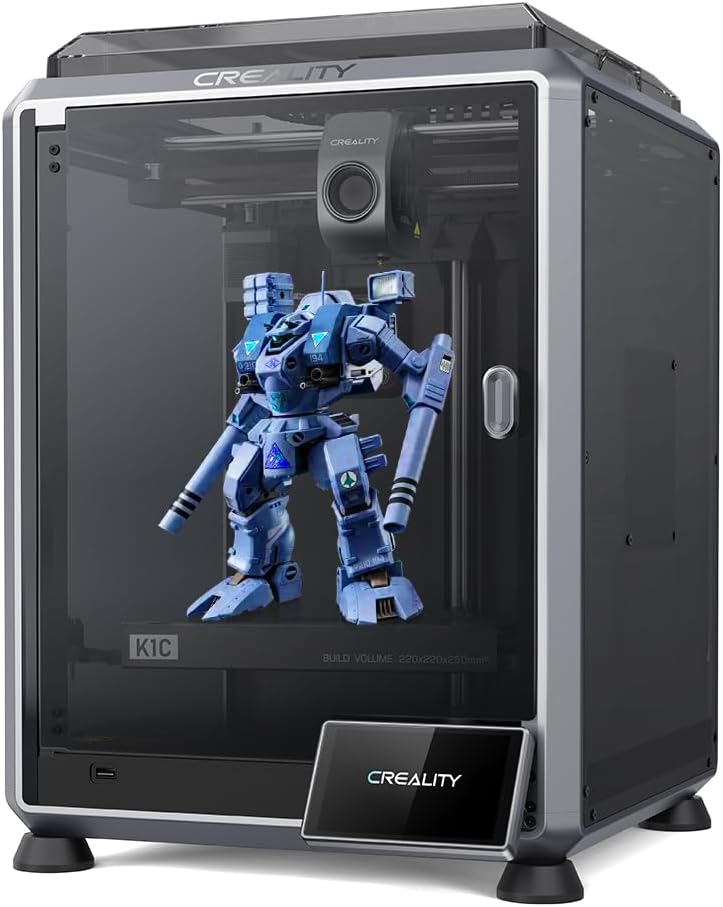
Creality K1C
4.3Editor score
300C nozzle temp
Direct extruder design
AI failure detection
This guide compares the top 3D printer for high temperature filaments including enclosed models, heated chambers, and high-temperature nozzles for engineering-g
Finding a reliable 3D printer for high temperature filaments requires careful consideration of chamber heating, nozzle capabilities, and build stability. Engineering materials like PC and Nylon demand consistent heat to prevent warping and ensure strong interlayer adhesion during complex prints.
We evaluated ten leading models based on their ability to handle abrasive and heat-sensitive materials. Our analysis focuses on enclosed designs, active chamber heating, nozzle temperature limits, and motion systems that maintain precision at high speeds for professional results.
Each selection below highlights specific strengths for different user needs ranging from hobbyists to industrial professionals. Prices and availability change frequently so always verify current details before purchasing to ensure you get the best value for your specific printing requirements today.
4.3Editor score

4.7Editor score

4.4Editor score
This side-by-side comparison highlights key specifications for each model including nozzle temperature limits chamber heating capabilities and build volume sizes to help you choose the right machine for engineering materials.



The Bambu Lab P2S Combo stands out as the top choice for engineers needing speed and multi-material versatility. With a 4.7 rating users praise its ability to handle advanced filaments while maintaining rapid throughput.
We may earn a commission when you buy through this link, at no additional cost to you.
Its Adaptive Airflow System ensures stable temperatures for engineering materials like ABS and ASA without warping. The PMSM Servo Extruder delivers consistent flow rates crucial for high-temperature parts requiring dimensional accuracy.
While the printer requires the Combo version for multi-color features the value remains high for professional workflows. The only trade-off is the initial investment but the time saved justifies the cost for active users.
Buy this if you need a reliable machine for functional prototypes and production parts. It balances speed quality and material support better than any other option currently available on the market.
The system automatically balances cooling and heat retention to keep overhangs crisp while maintaining a 50C chamber for engineering materials.
The AMS 2 Pro enables seamless multi-color printing with built-in filament drying keeping every spool ready for flawless prints.
We may earn a commission when you buy through this link, at no additional cost to you.
The Creality K1C offers exceptional value for users needing to print carbon fiber and high-temperature materials without breaking the bank. It supports up to 300C printing which covers most engineering plastics effectively.
We may earn a commission when you buy through this link, at no additional cost to you.
Its direct extruder grips filament tightly preventing slips during high-speed prints. The upgraded cooling structure minimizes stringing and warping ensuring consistent results even when working with challenging thermoplastics like ABS.
The lack of a fully active heated chamber means some warping may occur on large parts without additional mods. However for small to medium prints the performance remains impressive relative to the cost.
Choose this model if you are budget-conscious but still need reliable high-temperature capabilities. It is an excellent entry point into engineering-grade printing for hobbyists and small workshops.
The extruder uses a titanium alloy heatbreak to block heat creep while being easily swappable for maintenance.
Real-time monitoring detects failures like spaghetti or foreign matter to reduce waste during long prints.
We may earn a commission when you buy through this link, at no additional cost to you.
The FLASHFORGE Creator 5 Pro is designed for industrial environments needing robust thermal control and safety features. Its active chamber heating up to 65C ensures consistent interlayer adhesion for materials like PC and Nylon.
We may earn a commission when you buy through this link, at no additional cost to you.
Four independent extruders allow true multi-color printing without purging waste. The HEPA13 filtration system captures particles and odors making it safe for office or home environments without ventilation issues.
The multi-color system requires more calibration but eliminates the waste common in single-nozzle changers. Users appreciate the speed and reliability though the learning curve is steeper than entry-level machines.
Invest in this printer if you need industrial-grade throughput and safety. It delivers professional results for demanding projects where material quality and workspace cleanliness are priorities.
Maintains stable temperatures up to 65C to prevent warping when printing high-performance materials like ABS ASA PC and Nylon.
Four toolheads switch colors by swapping nozzles instantly without purging filament ensuring material purity and efficiency.
We may earn a commission when you buy through this link, at no additional cost to you.
The Bambu Lab P1S is a solid mid-tier option for users needing speed and enclosure benefits without advanced heating. It handles engineering filaments well and maintains print quality at high speeds.
We may earn a commission when you buy through this link, at no additional cost to you.
Its fully enclosed body improves stability for filaments like ABS and ASA. The automatic bed leveling ensures consistent first layers reducing the need for manual adjustments before each print job.
While capable with PC and Nylon the lack of active chamber heating may limit large part success. For smaller functional prototypes it remains a reliable choice with excellent ease of use.
Select this model if you need a balance of speed and simplicity. It is ideal for general engineering prints where active temperature control is not strictly required.
Fully enclosed body improves print performance for advanced filaments like ABS ASA PC and Nylon ensuring success rates.
Lightning-fast printing up to 500mm/s lets you focus on creating rather than waiting for standard prototypes.
We may earn a commission when you buy through this link, at no additional cost to you.
The Bambu Lab A1 brings professional calibration features to a compact open-frame design. It offers full-auto calibration and active flow rate compensation ensuring smooth prints without manual tuning.
We may earn a commission when you buy through this link, at no additional cost to you.
While primarily for beginners the accuracy makes it suitable for fine functional parts. The quiet operation and simplified interface make it accessible for home use where noise is a concern.
The open design limits high-temperature material success due to ambient cooling. It works best with standard engineering plastics rather than high-temp compounds requiring enclosed environments.
Choose this for precision prototyping where ease of use is paramount. It excels in environments requiring quiet reliable performance without complex setup requirements.
The printer takes care of calibration processes automatically ensuring optimal performance for every print without manual fuss.
The 1-Clip quick swap nozzle ensures convenient maintenance and provides versatile printing options without tools.
We may earn a commission when you buy through this link, at no additional cost to you.
The FLASHFORGE AD5X utilizes Independent Filament System (IFS) for multi-color printing without complex purging. It handles up to 300C nozzles allowing work with various high-performance engineering plastics.
We may earn a commission when you buy through this link, at no additional cost to you.
Its high-speed capability of 600mm/s reduces print times significantly without losing precision. The fully automatic leveling ensures consistent results saving time on setup for every new job.
While effective for multi-color the lack of chamber heating limits high-temp material reliability. It remains a strong choice for users needing speed and color variety in smaller projects.
Buy this for vibrant prototypes where color variety and speed are key. It offers a versatile solution for projects requiring multiple materials or colors in a single build.
The IFS technology allows printing with up to four different colors simultaneously creating vibrant models with ease.
A high-temperature nozzle reaching 300C allows work with a wide range of filaments including ABS PETG and Nylon.
We may earn a commission when you buy through this link, at no additional cost to you.
The Anycubic Kobra S1 Max offers a massive build volume and active chamber heating for large-scale engineering projects. With a 350C hotend and 65C chamber it handles tough materials like PC and PA6-CF easily.
We may earn a commission when you buy through this link, at no additional cost to you.
Its CoreXY motion system ensures stability at high speeds while vibration compensation reduces ringing. The AI monitoring system detects spaghetti failures saving material during long unattended prints.
The large volume allows printing full functional prototypes in one piece. However the brand support and community are smaller than competitors which may impact troubleshooting options for new users.
Select this for large engineering parts needing thermal stability. It is a strong contender for users needing size and temperature control in a single machine.
The 65C heated chamber handles advanced materials including ABS ASA PC PA and PET-CF without warping issues.
The titanium alloy throat tube and hardened steel nozzle provide enhanced durability for abrasive filaments like carbon fiber.
We may earn a commission when you buy through this link, at no additional cost to you.
The Flashforge AD5X brings CoreXY precision and high-temperature nozzles to a compact frame. It prints at 600mm/s allowing rapid prototyping while maintaining dimensional accuracy for complex parts.
We may earn a commission when you buy through this link, at no additional cost to you.
Its dual-band Wi-Fi allows remote monitoring and streaming from anywhere. The magnetic PEI plate ensures easy part removal and consistent adhesion for every print cycle without messy glues.
Lacking an active chamber it may struggle with high-temp materials in open environments. Adding the optional enclosure kit helps mitigate warping for more demanding engineering applications.
Choose this for speed and remote management needs. It fits well in workshops needing quick turnaround and reliable performance for standard engineering plastics.
Monitor prints from anywhere with dual-band Wi-Fi and HD camera for real-time streaming and shareable timelapses.
The 300C all-metal hotend prints ABS Nylon and Carbon Fiber ensuring a reliable upgrade to engineering-grade prints.
We may earn a commission when you buy through this link, at no additional cost to you.
The Snapmaker U1 uses a patented SnapSwap system to change toolheads in 5 seconds reducing waste and time. It allows true multi-material and multi-color prints without purging material between changes.
We may earn a commission when you buy through this link, at no additional cost to you.
Users can combine rigid and flexible materials easily making it unique for complex functional prototypes. The built-in library and open-source software simplify the workflow for both beginners and professionals.
The build volume is smaller than other engineering models limiting large part size. It remains a strong choice for detailed parts where material variety is more important than scale.
Invest in this for advanced prototyping needs. It delivers unmatched flexibility for projects requiring mixed materials or colors in a single operation.
The tool changer reduces tool change time from around 2 minutes to just 5 seconds saving time and waste.
Combine rigid and flexible materials water-soluble supports and engineering materials in a single print for freedom.
We may earn a commission when you buy through this link, at no additional cost to you.
The FLASHFORGE Creator 5 Pro offers near-zero waste switching for industrial multi-material prints. Its active chamber and CoreXY architecture deliver high-speed performance while preventing warping for tough engineering plastics.
We may earn a commission when you buy through this link, at no additional cost to you.
Remote control via Flash Studio allows full workflow management without physical presence. The dual HEPA system traps ultrafine particles ensuring safety during high-temperature printing sessions.
The initial setup requires calibration for multiple heads which demands patience. However the throughput gains justify the effort for users needing consistent color and material quality.
Choose this for industrial multi-material production. It is ideal for environments needing speed safety and low waste in complex printing tasks.
Switch nozzles without flushing filament eliminating massive purge waste and drastically slashing operational overhead.
Dual HEPA system traps particles while CoreXY structure eliminates ghosting ensuring rapid speeds without losing accuracy.
We may earn a commission when you buy through this link, at no additional cost to you.
Selecting the right 3D printer for high temperature filaments involves evaluating thermal control, build stability, and filament handling capabilities.
An enclosed chamber is essential for printing materials like ABS ASA and PC. It traps heat around the print reducing warping caused by ambient temperature fluctuations.
Look for fully sealed enclosures that maintain stable internal temperatures during long prints.
Active heaters maintain a set internal temperature regardless of room conditions. This is vital for large parts made of Nylon or PC where consistent interlayer adhesion is critical.
Ensure the model supports active heating up to 65C or higher for best results.
High-temperature nozzles must reach at least 300C to melt engineering filaments effectively. Standard nozzles often fail with these materials causing failed prints or clogs.
Choose a model with a 300C or higher nozzle rating for full compatibility.
Engineering parts often require larger footprints than standard prototypes. Ensure the build volume matches your project dimensions to avoid split printing.
Select a printer with a build volume of at least 220mm for functional prototyping.
CoreXY motion systems provide better stability and speed compared to Cartesian designs. This reduces vibration and ringing on high-temperature prints.
Prioritize models with rigid frames and vibration compensation features for clean surfaces.
Printing at high temperatures releases particles and odors. HEPA and activated carbon filters protect users in home or office environments.
Check if the printer includes HEPA13 filtration or compatible upgrades for safety.
If multi-color is needed look for independent toolheads or systems that do not require purging. This saves time and material during color changes.
Ensure the system is designed for multi-material compatibility before purchasing.
User-friendly software and auto-calibration reduce setup time. Reliable calibration ensures first layers adhere correctly even with high-temp filaments.
Select models with auto-bed leveling and remote monitoring to streamline the workflow.
Always preheat the chamber before starting a print to prevent early warping of the filament. Use materials recommended by the manufacturer to avoid nozzle clogging or mechanical stress.
Regularly clean the nozzle and PTFE lines to prevent residue buildup from high-temperature melts. Check calibration frequently since thermal expansion can shift alignment over time.
Store filaments in dry conditions to prevent moisture absorption which causes bubbling during high-temp printing. Maintain air filters and fans for optimal airflow and cooling performance.
Standard printers usually lack the necessary heated chamber and nozzle temperature to print materials like PC or Nylon reliably. You need a printer with at least 300C nozzle and an enclosed design for best results.
A heated chamber prevents warping by maintaining consistent temperatures around the print. Without it materials like ABS may cool too quickly causing corners to lift and layers to separate.
Basic tools like pliers and screwdrivers suffice for most maintenance tasks. Always refer to the manufacturer guide for nozzle changes to avoid damaging the hotend.
Use hardened steel nozzles and dry your filament properly before printing. Regularly run cleaning cycles to clear residue from the extruder path.
Ideally you want a stable temperature of 50C to 65C for materials like ABS PC and Nylon. This ensures good interlayer adhesion and reduces warping.
Yes high temperature printers can handle PLA just fine but you may need to adjust settings to prevent overheating. It is best to switch profiles based on material requirements.
Our top picks include the Bambu Lab P2S Combo for speed versatility and the FLASHFORGE Creator 5 Pro for industrial strength. These models offer the best balance of features for professional engineering needs.
When choosing prioritize features like active chamber heating and nozzle temperature over speed alone. These factors directly impact the success rate of high-temperature prints and long-term reliability.
Always check current pricing and availability before purchasing to ensure you get the best deal. Specifications may change so verify details on the product page to confirm compatibility.