
Power Queen Battery Balancer 48V
4.3Editor score
Supports LiFePO4 and Lead Acid
Low power standby mode
Auto balance at 10mV
This guide compares the top 12V 24V 48V Battery Equilizer Balancer models for extending battery life in RVs solar systems and more.
Managing multi-voltage battery banks requires precise control to prevent imbalance and premature failure. A quality battery equilizer balancer ensures each cell shares the load equally. This protects your investment and maximizes the efficiency of your energy storage system significantly.
We evaluated ten leading models based on compatibility, protection features, and balancing speed. Our analysis covers active and passive designs for lithium and lead-acid chemistries. Each product was assessed for reliability in demanding off-grid and marine applications today.
Each pick highlights unique strengths like LED displays or wide voltage ranges. We explain how these tools maintain system health over years of use. Prices fluctuate frequently so check current listings before making your final purchase decision.
4.3Editor score

4.3Editor score

4.1Editor score
This table provides a side-by-side comparison of key specifications for all ten models. It helps you quickly identify voltage ranges, battery types, and special features like LED displays.




The LiTime 48V Battery Balancer is a top-tier solution for maintaining health in large battery banks. With a 4.3 rating from users, it stands out for its robust active balancing capabilities. It ensures that all connected batteries reach an equal state of charge automatically.
We may earn a commission when you buy through this link, at no additional cost to you.
Its standout feature is the 10A maximum working current. This allows it to handle significant voltage differences between cells quickly. It is designed for battery banks up to 48V and works seamlessly with 24V and 36V systems. The device activates when a voltage difference exceeds 10mV and turns off when balance is achieved to save energy.
While it offers excellent protection features like reverse polarity and high temperature safeguards, users must note the installation order. It requires connecting batteries in parallel first before series. This is standard for this type of balancer but requires careful wiring planning.
This balancer is ideal for RV owners and off-grid system users who prioritize battery longevity. It supports multiple chemistries including LiFePO4 and lead acid. For those building a 48V system, this model provides the active control needed to maximize performance and lifespan.
The 10A current allows for rapid correction of voltage imbalances. This speed helps prevent cells from staying in a mismatched state for long periods.
Supporting 24V, 36V, and 48V makes this a flexible choice. You can use it for various configurations without needing multiple devices.
We may earn a commission when you buy through this link, at no additional cost to you.
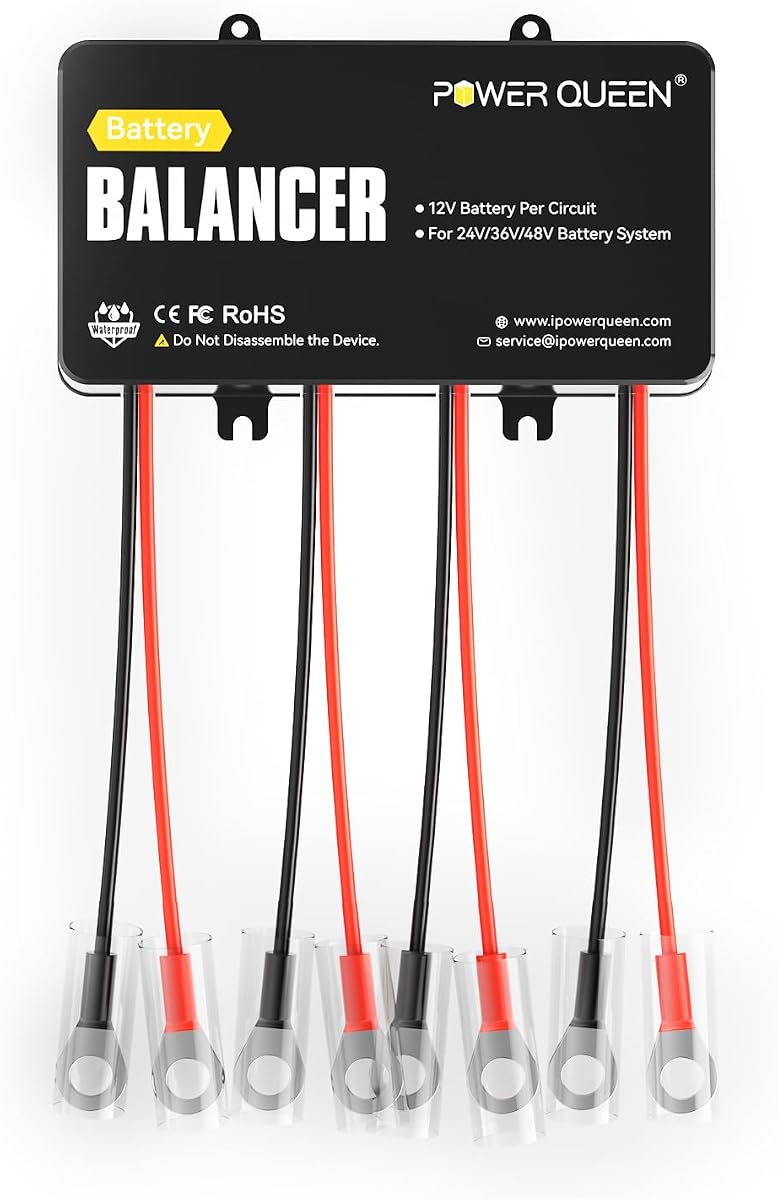
The Power Queen Battery Balancer offers an excellent balance of price and performance. With a 4.3 rating, it is trusted by many for solar and RV applications. It handles up to 48V banks and supports a wide range of battery chemistries effectively.
We may earn a commission when you buy through this link, at no additional cost to you.
Its key strength lies in its intelligent auto-balancing system. It activates when voltage differences exceed 10mV and switches to a low power standby mode when balanced. This ensures continuous monitoring without wasting energy. The device protects against reverse polarity and high temperatures to ensure safety.
Some users may find the specifications less detailed than premium options. However, it covers essential features needed for maintaining battery health. The instruction to connect in parallel first then series is critical for proper function and safety.
This model is perfect for budget conscious buyers who still want reliable protection. It works well for LiFePO4 and lead acid batteries. For small to medium battery banks, it provides the necessary equalization to extend service life.
Drawing only 5mA in standby mode conserves battery power. This is crucial for off-grid systems where every amp counts.
Supporting LiFePO4 and Lead Acid makes it versatile. You don't need to replace it if you change your battery chemistry.
We may earn a commission when you buy through this link, at no additional cost to you.
The MAZAVA HX02 offers a premium experience with visual monitoring capabilities. Its LCD display gives users real-time feedback on voltage status. This transparency helps in diagnosing issues early. It is designed for active balancing in 12V to 48V systems.
We may earn a commission when you buy through this link, at no additional cost to you.
The aluminum alloy shell provides better heat dissipation. This ensures the device stays cool even during intensive balancing sessions. It supports multi-module parallel setups allowing for expansion to higher voltages like 96V easily. The fast equalizer feature helps converge batteries to the same state quickly.
The higher cost is justified for users who need precise monitoring. It works best with lead acid batteries but supports wide voltage ranges. Installation might be slightly more complex due to the display and multi-module features.
Choose this if you value visibility and robust construction. It is a solid investment for professional setups where system health is critical. The combination of a monitor and sturdy build makes it a standout in the premium category.
The LCD display allows you to see voltages instantly. This removes guesswork during maintenance and troubleshooting.
Aluminum alloy shell ensures heat dissipates efficiently. This extends the life of the internal electronics in hot environments.
We may earn a commission when you buy through this link, at no additional cost to you.
Victron Energy is a known name in marine and renewable energy. This balancer is designed for series connected 12Volt batteries. It works by comparing voltages when the system charge voltage exceeds 27Volts. It draws current to equalize the state of charge across the bank.
We may earn a commission when you buy through this link, at no additional cost to you.
Its key feature is scalability. You can parallel multiple balancers to handle larger banks like 48V systems. This modularity allows for flexible system design. The 1A current is lower than others but sufficient for steady balancing.
The trade-off is the cost and the need for multiple units in larger systems. However, the reliability is often cited as a major plus. It eliminates the effect of load imbalance effectively. This makes it a safe choice for critical applications.
Buy this if you prioritize brand reliability over raw speed. It is excellent for marine setups or off-grid systems where maintenance is difficult. The proven track record of Victron products adds significant value to this investment.
Victron units are known for lasting in harsh conditions. This reduces the risk of premature failure in your battery bank.
Parallel multiple units for higher voltage banks. This flexibility allows your system to grow with your needs.
We may earn a commission when you buy through this link, at no additional cost to you.
The iSunergy Equalizer stands out for its high voltage capability. It supports battery banks up to 96V which is rare for consumer units. It works with single batteries in the range of 7V to 18V. This makes it suitable for various large scale storage projects.
We may earn a commission when you buy through this link, at no additional cost to you.
Its installation is simplified with rail-type buckle design. You can easily install the module in a distribution box. It supports lead acid, Li-ion, and Ni-Cd batteries. This versatility is crucial for mixed or diverse battery environments.
It lacks a display which means you rely on external monitors. The design is straightforward and functional. Users appreciate the flexibility to connect in series or parallel as needed. It is a workhorse for industrial or large off-grid setups.
Select this for projects requiring high voltage support. It simplifies the balancing of large banks effectively. The rail mount design saves space and time during installation. For high capacity systems, this offers practical value.
Handling up to 96V opens up large solar options. It allows you to scale your storage without custom solutions.
Rail buckle installation saves space and time. It fits neatly into distribution boxes for cleaner wiring.
We may earn a commission when you buy through this link, at no additional cost to you.
The HC02 Balancer provides a visual indicator for battery status. The LED display is a valuable feature at this price point. It connects four 12V batteries to ensure they stay balanced. It is designed for 24V and 36V systems as well.
We may earn a commission when you buy through this link, at no additional cost to you.
Safety features include low voltage disconnect to protect battery health. This prevents deep discharge which can damage cells. The reverse polarity protection adds a layer of security against wiring errors. It supports Lithium and Lead Acid types.
User ratings are slightly lower than other options. This might be due to simpler features or connectivity. However, it offers the essential functions needed for balancing. The display helps you monitor without extra tools.
This unit is good for users wanting a display on a budget. It handles common battery configurations effectively. For simple 48V banks, it offers a functional solution. Check reviews for specific use cases before purchasing.
The LED display lets you check voltages at a glance. This helps in spotting issues before they become serious.
Low voltage disconnect keeps batteries safe from drain. This is essential for extending the life of deep cycle cells.
We may earn a commission when you buy through this link, at no additional cost to you.
The Redodo 24V Balancer focuses on smaller battery banks. It manages two 12V batteries efficiently. With a 10A current it handles imbalances quickly. The LED display allows you to see the status easily. This is great for RVs with dual batteries.
We may earn a commission when you buy through this link, at no additional cost to you.
It includes high temperature protection to prevent overheating. This ensures safety during long balancing sessions. The unit comes with a 1-year warranty and professional support. This adds value for users needing assistance. It supports LiFePO4 and Lead Acid types.
It is limited to 24V so it cannot be scaled to 48V directly. However for many systems this is sufficient. The installation is straightforward with included cables. It works for both series and parallel-first-series setups.
Choose this for 24V systems where simplicity is key. The high current and display are strong selling points. For those with two batteries this provides reliable balancing. The warranty support makes it a trustworthy choice.
10A current ensures rapid equalization. This helps maintain peak efficiency in dual battery systems.
High temperature protection adds critical safety. It prevents damage during extreme weather conditions or heavy loads.
We may earn a commission when you buy through this link, at no additional cost to you.
The Power Queen 48V Equalizer offers solid balancing for various systems. It activates automatically when voltage differences exceed 10mV. This ensures continuous health of your battery bank. It switches to standby once balanced to save energy. This supports a wide range of battery types.
We may earn a commission when you buy through this link, at no additional cost to you.
The active balancing technology is efficient for multi-battery setups. It helps maintain charge levels without manual intervention. The device is designed for RV and off-grid applications. It supports LiFePO4 and Lead Acid chemistries effectively.
The protection features are standard reverse polarity and temperature. While functional they are not the most advanced. However it meets the needs of most users. The connection order instruction is important to follow.
This is a reliable choice for standard 48V banks. It balances performance and ease of use. For regular maintenance this model works well. It provides the necessary control for your energy system.
Active balancing ensures all cells stay uniform. This prevents one weak cell from dragging down the whole bank.
Universal battery support makes it versatile. You can use it with various chemistries without buying new devices.
We may earn a commission when you buy through this link, at no additional cost to you.
This affordable Equalizer provides basic functionality for balancing. It supports up to 96V systems. This makes it scalable for larger projects. The 5A current is sufficient for steady maintenance. It includes LED indicator lights to show status.
We may earn a commission when you buy through this link, at no additional cost to you.
The low voltage cutoff protects your batteries from over discharge. This is a vital safety feature for any setup. It works with a wide range of battery types including Ni-Cd. The design is simple and effective.
It lacks a detailed display but the lights give basic info. The build is adequate for indoor use. It is a practical option for those on a tight budget. Many users find it effective for small to mid banks.
Choose this if you need to stretch your budget. It covers the essentials of battery equalization. For basic maintenance it gets the job done. It is a cost-effective entry into active balancing.
Cutoff at low voltage prevents damage. This is key to avoiding dead batteries due to neglect.
LED lights show status without screens. This keeps the unit simple and affordable to produce.
We may earn a commission when you buy through this link, at no additional cost to you.
The HA01 LED Equalizer is designed for series connected batteries. It features a digital display for voltage readings. This adds convenience for monitoring your system. The flame retardant shell ensures safety. It optimizes current between 0 to 5A.
We may earn a commission when you buy through this link, at no additional cost to you.
It is suitable for 24V 36V and 48V systems. The high precision chips help reduce voltage deviation. This improves overall performance of the battery bank. Users find it durable and easy to install.
The current range is limited to 5A. This is fine for steady maintenance but not fast correction. It protects against reverse polarity and low voltage. The design supports various scenarios from cars to solar.
This model is ideal for those wanting a display. The build quality is solid for home or car use. It simplifies the balancing process significantly. For standard setups it offers great convenience and safety.
The LED digital display provides precise data. This helps in accurate monitoring of battery states.
Flame retardant materials reduce fire risks. This is crucial for high current battery environments.
We may earn a commission when you buy through this link, at no additional cost to you.
Choosing the right balancer involves understanding voltage ranges, battery types, and specific features. These factors ensure compatibility and longevity for your system.
Ensure the balancer supports your system's total voltage. Many units handle 24V or 48V but require checking limits. If you have a higher voltage bank you may need multiple units. This ensures safe operation and prevents device damage.
Choose a model that matches your battery bank voltage exactly.
Different chemistries like LiFePO4 and Lead Acid behave differently. The balancer must be compatible with your specific type. Some units are designed for lead acid only. Using the wrong type can cause safety risks. Always verify the supported battery list.
Select a universal model that supports your specific chemistry.
Higher current allows for faster equalization of voltage differences. Models with 10A current are faster than 1A units. However higher current generates more heat. You need a unit with good thermal management to maintain stability.
Look for a current rating that matches your system size.
Some balancers include LED or LCD displays. This helps you see voltage status without extra tools. It is useful for troubleshooting issues quickly. If you prefer simplicity a basic unit without display may suffice.
Decide if visual feedback is necessary for your setup.
Consider how the unit mounts in your system. Some use rail buckles for easy installation. Others require specific wiring orders like parallel first. Ensure you can install it securely without risking wiring errors.
Choose a mounting style that fits your enclosure.
Safety features like reverse polarity protection are vital. They prevent damage from wiring mistakes. High temperature protection ensures the unit does not overheat. Look for multiple protections to safeguard your investment.
Prioritize models with comprehensive safety protections.
A warranty adds peace of mind for expensive electronics. Check the length of the coverage provided by the seller. Good technical support helps resolve issues faster. This is key for long term reliability of your system.
Choose a brand with a strong warranty policy.
Active balancers use electronics to move charge between cells. Passive ones usually use resistors to dissipate excess. Active designs are more efficient and save energy. This is preferred for off-grid systems where power is limited.
Active designs are generally more efficient for modern setups.
First install the balancer in a well ventilated area to prevent overheating. Connect the wires carefully following the manual's polarity instructions. Ensure the connections are tight to avoid resistance and heat.
Regularly check the LED or LCD display to monitor battery status. Look for any warning indicators that suggest an imbalance. If the display shows high voltage differences investigate the batteries for issues.
Keep the unit clean and free of dust to maintain heat dissipation. Do not block the vents on the aluminum shell. Replace the unit if it shows signs of physical damage or failure.
Yes especially if you have multiple batteries in series. Balancers prevent cells from drifting apart which shortens life. They help maintain equal charge levels across the bank.
No a 24V balancer is rated for 24V only. Using it on 48V will damage it. You must use a balancer rated for your system voltage or multiple units.
Most balancers activate during charging or rest periods. They monitor voltage differences and correct them as needed. This helps ensure cells stay balanced during full charge cycles.
To support 48V connect multiple 24V balancers in parallel. Each handles a pair of batteries. Ensure they are installed according to the manufacturer's instructions for scaling.
Active balancing moves energy from high to low cells. Passive balancing uses resistors to burn off excess energy. Active is more efficient for off-grid systems.
It depends on the current and voltage difference. High current units finish faster. Once balanced the unit often switches to standby mode.
This guide reviewed top models like the LiTime and Power Queen balancers. These offer strong active balancing for various battery types. They protect against voltage imbalance effectively.
Prioritize voltage range and safety features when choosing. A display helps with monitoring but is not strictly required for all setups. Consider your budget and system size.
Prices and availability change frequently. Always check the latest listings before buying. Ensure you select the correct model for your specific battery configuration.