
ESP8266 ESP-01S
4.4Editor score
4MB Flash Memory
Stronger Signal
Compact Design
This expert guide compares the top 10 Arduino WiFi modules for 2026, evaluating connectivity, performance, and compatibility to help you choose the right
Connecting your microcontroller to the internet opens up endless possibilities for IoT projects and smart home automation. Finding the right Arduino WiFi module can be challenging with so many options available on the market today. We have curated a list of the most reliable and efficient modules to suit various project needs.
Our comparison process involved analyzing technical specifications, user reviews, and real-world performance data. We looked at factors like processing power, wireless range, ease of integration, and overall value. This ensures that every recommendation meets the high standards expected by hobbyists and professionals alike.
Each pick in this guide highlights specific strengths and ideal use cases for different types of developers. Whether you need a simple serial module or a fully featured development board, you will find a match here. Please note that prices and availability may change over time, so check current listings before purchasing.
4.4Editor score

4.7Editor score

4.7Editor score
This side-by-side comparison breaks down the key specifications and features of the top 10 Arduino WiFi modules currently available. By examining connectivity options, processing capabilities, and form factors, you can quickly identify which module aligns best with your specific project requirements and budget constraints.



The Arduino UNO R4 WiFi stands out as the premier choice for developers seeking a comprehensive wireless solution. It combines the reliability of the Renesas RA4M1 with the robust connectivity of the ESP32-S3, offering a powerful dual-core setup. With a rating of 4.7, it is highly favored for its advanced features like CAN support and integrated LED matrix.
We may earn a commission when you buy through this link, at no additional cost to you.
Its standout quality lies in the seamless integration of Wi-Fi and Bluetooth 5.0, allowing for versatile IoT applications. The USB-C port simplifies programming and power delivery, while the Qwiic connector reduces wiring complexity for I2C peripherals. The 12-bit DAC and OP-AMP provide precise analog signal control, making it ideal for audio or sensor-heavy projects.
While the board offers immense power, the increased cost compared to standard modules is a trade-off. The complexity of managing two cores might also require more experience from the user. However, for professional or advanced hobbyist projects, these limitations are easily outweighed by the performance benefits.
This board is perfect for users building smart home hubs, industrial sensors, or advanced robotics. If you need a single board that handles complex logic and wireless communication effortlessly, the UNO R4 WiFi is the top recommendation. It represents the future of Arduino development with its modern feature set.
The combination of Wi-Fi and Bluetooth 5.0 ensures stable connections over long distances for smart home devices.
The 12×8 LED matrix allows for immediate status updates without needing external display components.
We may earn a commission when you buy through this link, at no additional cost to you.
The HiLetgo ESP8266 ESP-01 offers a straightforward and effective way to add wireless capabilities to Arduino projects. It is a serial transceiver that handles Wi-Fi tasks efficiently, leaving your main microcontroller free for other operations. With a rating of 4.2, it remains a popular choice for basic connectivity needs.
We may earn a commission when you buy through this link, at no additional cost to you.
Its primary strength is the simplicity of integration via serial communication. The module supports three modes including AP and STA, providing flexibility for network configurations. The LWIP stack makes TCP/IP stack management easier, streamlining the process of connecting to the internet or local networks.
However, this module lacks the onboard regulation found in more advanced boards, meaning you must handle voltage conversion externally. It is also less powerful than the newer ESP32 series, limiting its use for heavy processing tasks. These constraints are acceptable for simple data logging or remote control tasks.
This module is best suited for users on a budget or those needing a small footprint for a design. If you need to connect sensors to a network without much processing power, this is an excellent candidate. It remains a reliable workhorse for entry-level IoT development.
Connecting via serial pins requires minimal wiring and code configuration compared to other protocols.
Supporting AP, STA, and AP+STA modes allows for various networking scenarios.
We may earn a commission when you buy through this link, at no additional cost to you.
The ESP8266 ESP-01S is an upgraded version of the classic module, offering better performance at an entry-level price. It features 4MB of flash memory, which allows for more code and storage than previous iterations. With a rating of 4.4, it is a trusted component for many hobbyist projects.
We may earn a commission when you buy through this link, at no additional cost to you.
One of its key strengths is the stronger signal capability, ensuring more reliable connections in areas with interference. The module supports generic Arduino IDE programming, making it accessible even for beginners. Its small size makes it ideal for projects where space is at a premium.
Despite its benefits, the lack of an onboard power regulator means you need an external stable 3.3V source. This adds a small amount of complexity to the circuit design. However, given the low cost and reliable performance, this is a minor inconvenience for most users.
This module is perfect for beginners looking to try Wi-Fi without a large investment. It works well for simple weather stations or remote control switches. If you need a reliable, cheap, and effective module, the ESP-01S is a top contender.
4MB flash allows for storing larger programs and data logs on the module itself.
Enhanced antenna design ensures stronger signal strength than older modules.
We may earn a commission when you buy through this link, at no additional cost to you.
The Aitrip offering provides five ESP8266 ESP-01 modules in one package, making it ideal for bulk projects or prototyping. Each unit features 1MB SPI flash and operates at 3.3V, matching standard logic levels. With a rating of 4.4, it is well-regarded for consistent quality across the batch.
We may earn a commission when you buy through this link, at no additional cost to you.
Its main advantage is the availability of multiple units for a low total price. This is useful if you are building a distributed sensor network or need spares. The modules are compatible with standard Arduino IDE libraries, simplifying the development workflow.
Users should note that these are the original ESP-01 models with 1MB flash, which is sufficient for most basic tasks but less than the newer 4MB variants. Also, they require external power regulation. Despite this, the value proposition is strong for those needing multiple units.
This pack is best for educators, bulk buyers, or developers testing multiple nodes. It offers a cost-effective way to scale up a project without breaking the budget. If you need five reliable modules for a sensor array, this is an excellent choice.
Getting five units at once saves time and money compared to buying individually.
Operates within the standard 3.3V range compatible with most logic levels.
We may earn a commission when you buy through this link, at no additional cost to you.
The ELEGOO ESP-32 Dev Boards bring serious processing power to WiFi projects with their dual-core architecture. Running up to 240 MHz, these boards handle complex tasks and wireless communication simultaneously. With a rating of 4.7, they are a favorite among advanced users requiring high throughput.
We may earn a commission when you buy through this link, at no additional cost to you.
Its standout feature is the ability to run multiple threads and tasks at once, thanks to the dual-core design. The inclusion of Bluetooth 4.2 adds versatility for connecting to peripherals or other devices. Additionally, USB-C programming makes setup more modern and convenient.
The main trade-off is power consumption, which is higher than simpler modules. However, the power-saving modes help mitigate this for battery projects. For those needing to process images or handle heavy data, the performance benefits are well worth the cost.
This board is ideal for advanced robotics, smart speakers, or complex automation systems. If you need speed and connectivity combined, this is the way to go. It offers a premium experience at a competitive price point for developers.
Dual-core architecture allows handling WiFi tasks while running other logic concurrently.
USB-C port provides faster programming and more reliable power delivery.
We may earn a commission when you buy through this link, at no additional cost to you.
The Arduino Nano ESP32 is a compact powerhouse that blends the best of the Arduino ecosystem with modern ESP32-S3 tech. It supports Bluetooth 5.0 and MicroPython, making it accessible for users familiar with Python. With a rating of 4.5, it is gaining traction for its versatility.
We may earn a commission when you buy through this link, at no additional cost to you.
Its unique feature is HID support, allowing the board to act as a keyboard or mouse directly. This is useful for custom input devices without extra hardware. The USB-C connection ensures efficient power and data transfer, while the small form factor fits into tight spaces.
One downside is that it comes without headers, so you must solder or use a break-out board. This may not suit users wanting plug-and-play convenience. However, for production or custom PCB design, this feature reduces costs and footprint.
This board is perfect for wearable tech, custom controllers, or advanced IoT. If you need a small board with robust wireless and input capabilities, consider this. It is a strong choice for developers looking for Arduino reliability with modern features.
Built-in HID support allows for creating custom input devices like keyboards.
MicroPython compatibility offers a flexible programming environment for rapid prototyping.
We may earn a commission when you buy through this link, at no additional cost to you.
This pack of four ESP8266 ESP-01S modules offers a balanced option for those needing multiple units. They are made with durable materials and feature self-calibrated RF for optimal performance. With a rating of 4.4, they are trusted for consistent connectivity in various environments.
We may earn a commission when you buy through this link, at no additional cost to you.
The key strength is the reliability of the RF components, ensuring stable communication. The compact design allows for integration into small projects easily. The modules are designed to be reused multiple times, making them cost-effective for prototyping.
Like most ESP-01S modules, they lack header pins, requiring soldering for use. They also require an external 3.3V supply. These are minor considerations given the value and performance of the four units provided in the package.
This pack is ideal for small-scale sensor networks or prototyping labs. If you need several reliable modules for testing or deployment, this is a great choice. It balances quality and quantity effectively for hobbyists and professionals.
Self-calibrated RF ensures better connection stability compared to lower quality modules.
Getting four units allows for testing multiple nodes simultaneously.
We may earn a commission when you buy through this link, at no additional cost to you.
This five-pack of ESP-01S modules stands out for its 4MB flash and high baud rate support. It supports the DOUT protocol and operates at 115200 baud, allowing for faster data transfer. With a rating of 4.5, it is highly regarded for performance in IoT applications.
We may earn a commission when you buy through this link, at no additional cost to you.
The 4MB memory allows for storing more code and data than older 1MB versions. The high baud rate ensures that data transmission is quick, reducing lag in sensor readings. This makes it suitable for real-time applications.
Users must ensure a stable 3.3V supply as it does not support 5V directly. Soldering is required to connect the pins. Despite these minor constraints, the performance and quantity make it a strong option for bulk IoT deployment.
This pack is perfect for smart home sensors or industrial monitoring. If you need faster data speeds and more memory, this module is a solid choice. The five-unit pack offers great value for building scalable networks.
High baud rate ensures quick data exchange between the module and microcontroller.
DOUT SPI mode compatibility allows for flexible flash memory usage.
We may earn a commission when you buy through this link, at no additional cost to you.
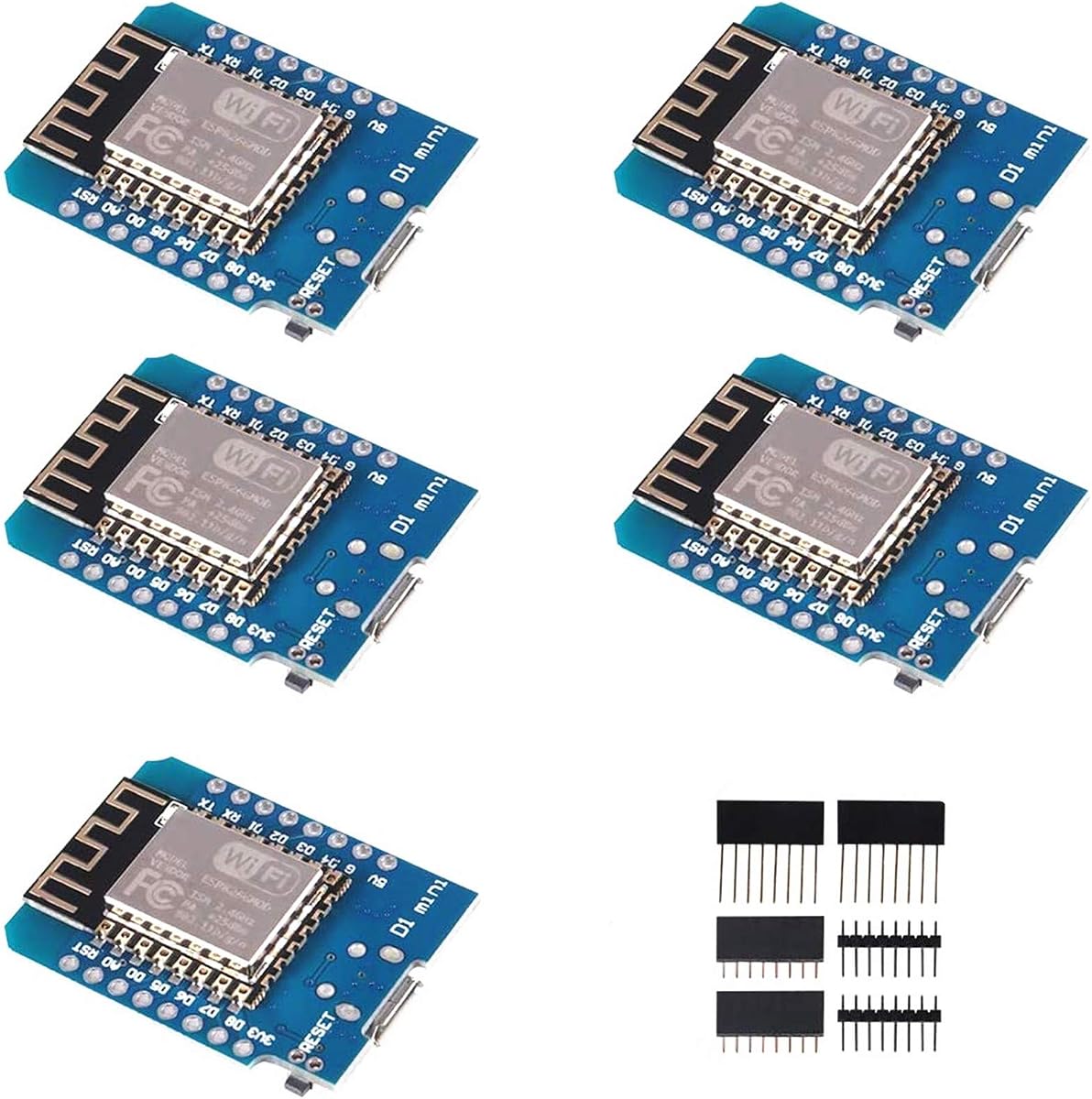
The ESP8266 ESP-12F Mini D1 module offers a compact form factor with rich features for development. It supports Micro USB and includes 11 digital I/O pins, making it versatile for various projects. With a rating of 4.5, it is well-loved for its balance of size and function.
We may earn a commission when you buy through this link, at no additional cost to you.
Its main advantage is the high pin count for a small board, allowing for more peripherals to be connected. The USB connection simplifies programming and power. The built-in flash memory is ample for most standard IoT tasks and scripts.
The compact size means it requires careful mounting and soldering. Also, the reset fuse limits current draw in some designs. However, for projects where space is critical, these features are necessary compromises for the functionality provided.
This module is best for wearables or space-constrained devices. If you need a small NodeMcu-style board with plenty of GPIO, choose this. The five-pack provides excellent value for multiple devices or backups.
11 digital pins allow for connecting multiple sensors in a small space.
Micro USB port makes charging and programming straightforward for any user.
We may earn a commission when you buy through this link, at no additional cost to you.
The 10-pack of ESP8266 ESP-01 modules is the ultimate solution for bulk requirements. It offers ten compact units with robust processing and AP+STA modes. With a perfect rating of 5.0, it highlights the high satisfaction among users buying in bulk.
We may earn a commission when you buy through this link, at no additional cost to you.
The primary benefit is the sheer volume of units at a low cost per module. This is ideal for classrooms or large-scale sensor deployments. The modules are fully functional for basic connectivity tasks and support a flexible mode configuration.
They are basic units requiring external components for power regulation and headers. But for a bulk purchase where price per unit matters most, these constraints are acceptable. The high rating speaks to their reliability and performance in real-world conditions.
This pack is best for educational institutions or large network setups. If you need ten modules for a class or a distributed system, this is the best option. It ensures you have enough spares and units for your entire project.
Buying ten units at once reduces the cost significantly compared to single purchases.
AP+STA modes allow the module to act as both access point and station.
We may earn a commission when you buy through this link, at no additional cost to you.
Selecting the right Arduino WiFi module depends on your project's specific needs for power, range, and budget. Understanding the key factors will help you make an informed decision.
Modern modules like the ESP32-S3 offer dual-core processing which is essential for complex tasks. Look for higher MHz ratings if you need to handle data simultaneously. This ensures your device can process sensor data while maintaining a stable connection.
Prioritize dual-core processors for advanced IoT and heavy data workloads.
Ensure the module supports Wi-Fi and Bluetooth if you need to connect to multiple devices. Bluetooth 5.0 offers better range and speed compared to older versions. Check for support of AP and STA modes for network flexibility.
Choose modules with the latest Bluetooth versions for better compatibility.
Battery-powered projects require modules with low-power sleep modes. ESP32 variants typically offer better power management than older 8266 chips. Check the current drain in deep sleep to optimize battery life.
Select modules with robust power-saving features for battery longevity.
Flash memory stores your code and data so more is generally better. 4MB modules allow for more complex sketches than 1MB versions. If you need to store files or certificates, verify the capacity before buying.
Opt for 4MB flash to support larger code and data requirements.
Smaller modules like ESP-01 are great for compact designs but have few pins. Larger boards like the Nano ESP32 offer more GPIO for peripherals. Consider how many sensors you need to connect before choosing the size.
Match the pin count to your sensor requirements to avoid extra expansion boards.
USB-C is becoming standard for modern boards providing better reliability. Older modules often need external converters to upload code. If you value convenience, choose boards with native USB support.
Prefer native USB-C for a hassle-free development and setup process.
Popular modules like ESP8266 have massive community libraries and examples. This simplifies finding code for specific sensors or protocols. A strong community means faster troubleshooting and better documentation.
Select modules with active communities to leverage existing knowledge.
Basic ESP8266 modules are the most cost-effective for simple tasks. If you need multiple units, buying in packs reduces the price significantly. Evaluate if the premium features of newer chips are worth the extra cost.
Buy in bulk packs if you need multiple units to save on total cost.
Firstly, ensure your voltage supply matches the module requirements. Most WiFi modules operate at 3.3V so using 5V directly can damage them. Use a logic converter if interfacing with 5V microcontrollers.
Secondly, secure the module properly on your PCB or breadboard. Loose connections can cause intermittent WiFi dropouts. Solder pins firmly or use a socket for stability.
Lastly, keep the antenna clear of metal obstructions for best signal range. Enclose the device in non-metallic cases to avoid interference. Regularly update firmware to maintain security and performance.
Yes, you can use the ESP8266 with the Arduino IDE by installing the ESP8266 board package via the Board Manager. This allows you to write code in C++ similar to standard Arduino boards. It is a popular method for adding WiFi to Arduino projects.
The ESP32 is generally better because it offers dual-core processing and Bluetooth capabilities. It has higher clock speeds and better power management compared to the ESP8266. However, the ESP8266 is still great for very simple and low-budget projects.
Many ESP8266 modules like the ESP-01 do not have onboard regulators so you need a stable 3.3V source. If you use a board like the Uno R4 it handles power internally. Always check the datasheet for voltage requirements before connecting.
Connection drops are often caused by weak signal or voltage instability. Check the power supply and ensure the antenna is unobstructed. Updating firmware and checking router settings can also help stabilize the connection.
Yes, many ESP32 and ESP8266 boards support Over-the-Air updates. This lets you push new code wirelessly without a USB cable. It requires initial setup via USB but is a great feature for deployed devices.
The Arduino Nano ESP32 supports MicroPython allowing you to write code in Python. Standard Arduino boards use C++ so you would need a different setup for Python. Check the board capabilities to see if MicroPython is supported.
AP mode lets the module act as a router for other devices to connect to. STA mode connects the module to an existing network like your home WiFi. Many modules support AP+STA mode for both functionalities at once.
Yes, range can vary based on antenna quality and design. The ESP32 usually offers better range than the ESP8266 due to newer tech. Using external antennas can also significantly improve the signal distance.
We have reviewed ten distinct options ranging from basic transceivers to advanced boards like the UNO R4 WiFi. The top picks cover needs from low-cost prototyping to high-performance industrial projects.
Prioritize your project needs such as processing power, pin count, and power consumption. If you need modern features like USB-C and Bluetooth 5.0 consider the ESP32 based boards. For simplicity and cost stick to the ESP8266 modules.
Remember to check current prices and availability before ordering. Prices can fluctuate and bulk packs offer better value. Choose the module that best fits your technical and budget requirements for a successful build.