
SHILLEHTEK Universal Power Supply Module
4.6Editor score
Dual voltage 3.3V and 5V output
Flexible DC 6.5 to 12V input
Compatible with MB102 breadboards
This guide compares the top 12V breadboard power supplies for makers and students. We evaluate voltage options, current capacity, safety features, and ease of
Finding a reliable 12V breadboard power supply is essential for electronics hobbyists and professionals. A good module ensures stable voltage delivery to your microcontrollers and sensors without risking damage from fluctuations. This guide highlights the best options available for seamless prototyping.
We compared ten top-rated power supply modules based on input flexibility, output voltage options, current capacity, and safety protections. Each product was evaluated for compatibility with standard breadboards and ease of integration into your existing workspace setup for efficient circuit testing.
Each pick showcases key features like adjustable voltage, LED indicators, and connector types to match your specific project needs. Prices and availability may change frequently so verify current details before purchasing to ensure you get the best value for your electronics budget today.
4.6Editor score

4.5Editor score

4.5Editor score
This side-by-side comparison highlights the key specifications of each power supply module to help you identify the best fit for your prototyping needs based on voltage requirements and input options.




This 2-Pack module stands out with a 4.5 rating for its dual-channel flexibility and modern input options. It is ideal for users who need to power multiple devices with different voltage requirements simultaneously without additional wiring or external regulators.
We may earn a commission when you buy through this link, at no additional cost to you.
The independent right and left channel control allows you to run one side at 3.3V and the other at 5V easily. With onboard short-circuit and over-current protection it safeguards your Arduino or ESP32 from damage during prototyping phases efficiently.
While current output is limited to 1A for 3.3V and 2A for 5V this is sufficient for most low-power sensors and microcontrollers. The concave design ensures it sits flush on the breadboard saving valuable tie points for your component connections.
Whether you are setting up a multi-station lab or need a spare module for quick projects this pack offers excellent versatility. Its combination of Type-C and DC inputs means you can use modern chargers or standard adapters with ease and convenience.
Having separate switches for each channel means you can power just one rail to save energy or isolate components for debugging without unplugging wires.
Supporting Type-C USB input makes it future proof and compatible with power banks or chargers you likely already own for portable testing setups.
We may earn a commission when you buy through this link, at no additional cost to you.
With a high 4.6 rating this module delivers great value for budget-conscious makers who need reliable power for Arduino or Raspberry Pi projects. It ensures your electronic designs run efficiently without breaking the bank on expensive power solutions.
We may earn a commission when you buy through this link, at no additional cost to you.
Its design focuses on universal compatibility with MB102 breadboards and popular microcontrollers like ESP32. You can power it via USB for portability or DC 6.5-12V for stable lab bench testing depending on your environment and project needs.
The dual voltage output allows you to select 3.3V or 5V via jumper caps ensuring your sensors get the exact power they require. This simplifies wiring and reduces the risk of accidental over-voltage damage to sensitive components during testing.
While it lacks advanced features like adjustable output it excels at being simple and stable for everyday prototyping. If you need a straightforward power source that works every time without complex setup this is an excellent affordable choice.
Compatible with Arduino and ESP32 it removes compatibility worries so you can focus on coding and circuit design instead of power supply troubleshooting.
The ability to use USB means you can easily take your projects on the go for demonstrations or field testing without needing a wall outlet.
We may earn a commission when you buy through this link, at no additional cost to you.
This premium adapter stands out with a 4.5 rating and an impressive ability to adjust voltage from 3V to 24V with real-time LCD display. It is perfect for advanced users who need precise power control for various electronics beyond standard breadboard rails.
We may earn a commission when you buy through this link, at no additional cost to you.
Safety is a top priority here with built-in over-current over-voltage and short-circuit protection. The FCC and CE certifications ensure it meets high safety standards for indoor use without risks of fire or spontaneous combustion during long testing sessions.
The included alligator clips allow you to connect bare wires directly to breadboards making it versatile despite not being a dedicated breadboard module. With 72W output it can power multiple devices or high current motors without dropping voltage under load.
While it is larger than standard modules the flexibility and power capacity make it a powerful tool for serious prototyping. If you need one adapter to handle every voltage requirement from small sensors to large motors this is the top premium choice.
The LCD display ensures you know exactly what voltage is being delivered so you can fine tune settings for sensitive analog circuits confidently.
With over a dozen DC tips and alligator clips it adapts to almost any device or project requirement without needing extra adapters or cables.
We may earn a commission when you buy through this link, at no additional cost to you.
This kit is designed for beginners who need everything in one box to start prototyping Arduino or Raspberry Pi projects quickly. It includes a breadboard power module, jumper wires, and a dedicated 12V adaptor to ensure stability right out of the box.
We may earn a commission when you buy through this link, at no additional cost to you.
The power module supports 3.3V and 5V outputs with an input range of 6.5V to 12V. This versatility allows you to use USB power or the included adapter for stable supply during development phases or testing sessions in your workspace.
While the current is limited to 700mA it is enough for most sensors and microcontrollers. The inclusion of a full breadboard makes it easy to build circuits immediately without needing to source components separately or separately.
It is an excellent entry point for students or hobbyists starting their electronics journey. The package simplifies setup by providing all essential parts together though advanced users might prefer buying modules separately for more flexibility and upgrades.
Getting a breadboard and power module together saves time and money for new builders who need a functional workspace immediately without extra shopping.
The included 12V 1A adaptor is sized correctly for the module ensuring consistent voltage delivery that keeps your experiments running smoothly and safely.
We may earn a commission when you buy through this link, at no additional cost to you.
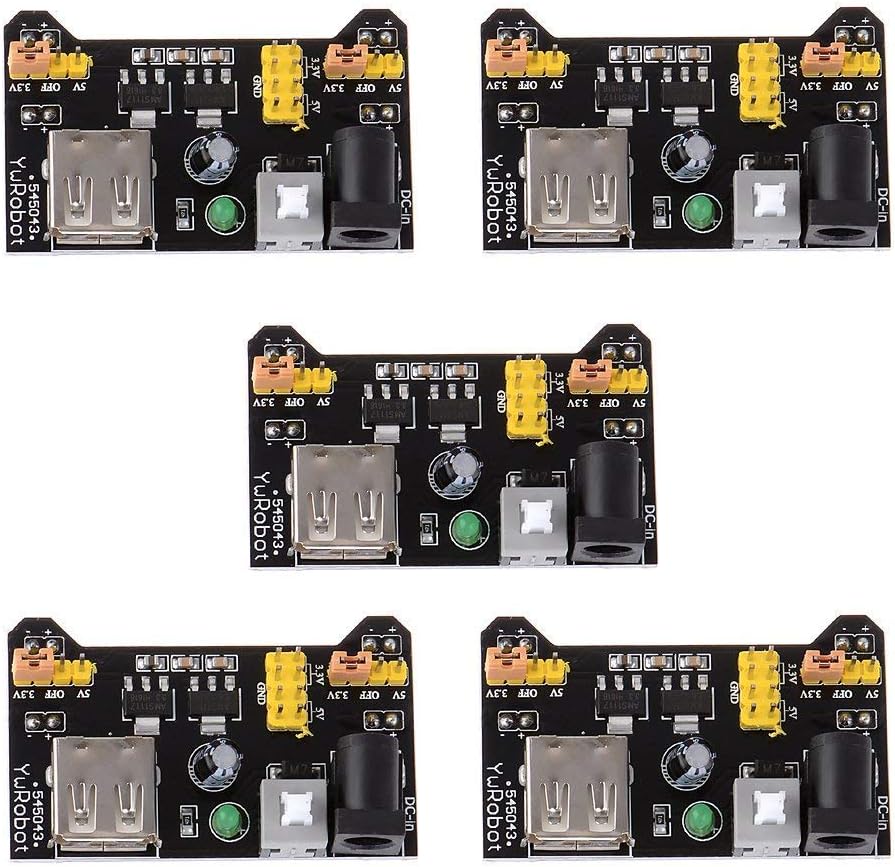
This 5-pack solution is perfect for classrooms or workshops where multiple power sources are needed. It includes connectors for 9V batteries and supports standard breadboard rails, making it a versatile choice for groups building electronics projects simultaneously.
We may earn a commission when you buy through this link, at no additional cost to you.
Each module offers a fixed regulated output of 3.3V or 5V via a simple jumper. A green LED provides visual confirmation of power status so users can quickly check if their circuit is active before starting work on prototypes.
The plug-and-play design eliminates the need for extra wiring saving time on setup. With a maximum output of 700mA it is suitable for general learning experiments and circuit testing that do not require high current components.
While it lacks advanced voltage tuning the value of five reliable units is unmatched for bulk needs. If you are outfitting a lab or need spares for various teams this bulk pack ensures everyone has access to stable power easily.
Having five units means you can set up multiple projects at once without sharing equipment or waiting for others to finish their power setup tasks.
The green LED indicator helps you instantly see which channels are active reducing confusion when working with complex wiring setups or multiple boards.
We may earn a commission when you buy through this link, at no additional cost to you.
This module is compatible with both 400 and 830 point breadboards ensuring it fits most standard prototyping needs. It supports USB power supply or DC 6.5-12V input giving you flexible options for powering your Arduino or sensor circuits.
We may earn a commission when you buy through this link, at no additional cost to you.
Output voltage is selectable between 3.3V and 5V to match your component requirements. With a maximum output current of 700mA it handles small electronics well without risking overload or voltage drops during normal usage phases.
Inclusion of 9V battery connectors adds portability to your projects so you can test circuits outside of a powered bench environment. This is especially useful for robotics or IoT demos where mobility is essential for showing results effectively.
While it does not offer adjustable voltage its fixed regulated output is stable for most common tasks. For users who need a simple replacement module or a spare unit for their workshop this provides reliable performance at an affordable price.
Compatibility with both small and large breadboards means you can use the same module across different project scales without needing adapters.
The included 9V connectors let you switch to battery power quickly for field tests or demos without needing access to a wall outlet nearby.
We may earn a commission when you buy through this link, at no additional cost to you.
HiLetgo is known for reliable electronics components and this module is no exception. It fits standard MB102 breadboards perfectly and provides 3.3V and 5V outputs through onboard pins making it easy to plug into existing prototyping setups easily.
We may earn a commission when you buy through this link, at no additional cost to you.
The input voltage range of 6.5V to 9V supports most standard barrel jack adapters or USB power sources. While slightly narrower than others it is sufficient for most bench applications where a stable power source is available nearby at all times.
Current output is rated at 700mA maximum which is adequate for small sensors and microcontrollers like Arduino or ESP32. A pack of five ensures you have spares for future projects or can distribute them across multiple workspace stations easily.
If you need a no-fuss replacement for older kits or want to add more power options to your lab this is a solid choice. It offers straightforward performance without extra features that might complicate simple projects or basic prototyping tasks.
HiLetgo components are known for durability and consistency giving you peace of mind that your power supply will perform reliably over time.
Standard pin spacing and design mean you can replace broken modules or add new ones without needing to modify your breadboard setup layout.
We may earn a commission when you buy through this link, at no additional cost to you.
SunFounder's BreadVolt module offers high current output with 1.5A on 5V and 1A on 3.3V rails. This makes it suitable for projects needing more power like Raspberry Pi or multiple sensors without risking voltage drops under higher load conditions.
We may earn a commission when you buy through this link, at no additional cost to you.
It includes a USB output port which is a unique feature allowing you to power other USB devices directly from the module. This versatility is helpful for IoT projects or robotics where you need to charge modules or power external accessories conveniently.
The compact size fits neatly on breadboards without taking up valuable space for components. Two independent channels allow you to separate power domains in your circuit for better organization and easier troubleshooting during the prototyping process.
While it lacks adjustable voltage its higher current capacity sets it apart from standard modules. If you need robust power for Pi projects or want extra USB charging capability this module provides modern features at a reasonable price point for hobbyists.
The higher amperage means you can run motors or brighter LEDs without worrying about brownouts or unstable performance during testing.
The extra USB port simplifies charging or powering peripherals so you don't need a separate cable for every device in your project.
We may earn a commission when you buy through this link, at no additional cost to you.
This module earns the highest rating of 4.8 by offering both fixed and adjustable voltage outputs with an input range up to 40V. It is ideal for advanced users who need flexibility to test various components with different power requirements in one setup.
We may earn a commission when you buy through this link, at no additional cost to you.
Supporting 3.3V, 5V, 12V, and adjustable channels makes it versatile for almost any electronics project. The switching design ensures high efficiency and less heat compared to linear regulators which is beneficial for prolonged testing periods.
While it is not specifically designed to plug into breadboards it can be connected via jumper wires to power rails. This flexibility allows you to tailor voltage output to exact needs without needing multiple fixed voltage modules for different projects.
If you need a flexible power source that grows with your skills this module offers excellent versatility. With the right setup it can handle everything from low-power sensors to higher voltage motors making it a powerful addition to your lab.
The adjustable output lets you test components at specific voltage levels to find optimal performance parameters during your design process easily.
Switching regulators convert power more efficiently reducing heat buildup and allowing for continuous operation without thermal issues during experiments.
We may earn a commission when you buy through this link, at no additional cost to you.
This DIY kit lets you assemble your own power supply with an LM2596 module and digital display. It is perfect for makers who want to learn electronics assembly while getting a powerful multi-output solution for breadboard prototyping.
We may earn a commission when you buy through this link, at no additional cost to you.
It integrates multiple outputs into one board reducing wiring mistakes and setup time. The built-in digital display allows you to see voltage levels instantly helping you fine-tune settings and confirm settings before connecting your circuit components safely.
In addition to standard outputs it includes options for negative voltage support for advanced analog circuits. This feature is rare in standard modules and gives you greater flexibility for testing audio or specialized sensor circuits easily.
While it requires soldering skills the educational value and functionality make it a rewarding project. If you want to upgrade your workspace with a custom power source and enjoy building electronics this kit is an excellent intermediate challenge.
The digital display removes guesswork from your power settings so you know exactly what voltage is flowing to your circuit at all times.
Having access to negative voltage expands the types of circuits you can build including analog signal processing or audio projects easily.
We may earn a commission when you buy through this link, at no additional cost to you.
Selecting the right power supply involves considering voltage needs, input types, and safety features to ensure stable operation for your electronics projects.
Most projects need 3.3V for modern microcontrollers or 5V for classic Arduino components. Check if the module allows selection via jumpers or switches to match your component requirements without needing external regulators.
Look for modules that offer 3.3V and 5V outputs to cover most common needs. Adjustable models give more flexibility but fixed options are simpler and more stable for general use.
Input voltage typically ranges from 6.5V to 12V DC for standard modules. Some support USB power which adds portability or Type-C for modern charging standards. Ensure your chosen power source matches the input specs.
Modules accepting 6.5V to 12V offer good flexibility for using existing adapters. USB options are great for mobile use but ensure they can deliver enough current for your circuit.
Most budget modules are rated for 700mA or less which suits small sensors. Advanced models offer higher current up to 1.5A or more for devices like Raspberry Pi. Check your component's current draw to avoid brownouts.
Higher current capacity allows for more complex projects with multiple devices. Ensure the power supply can meet the total load of your circuit plus a safety margin.
Short-circuit and over-current protection prevent damage to your expensive microcontrollers during wiring errors. Look for onboard regulators and protections to ensure safe operation under varying load conditions or accidental shorts.
Always choose a module with built-in protection. It safeguards your work and gives you confidence to test circuits without worrying about burning out components.
Standard MB102 or 830-point breadboards require modules that plug directly into the power rails. A concave design saves tie points. Verify the module fits your breadboard size to avoid space issues or loose connections.
Ensure the module pins match your breadboard holes. A secure fit prevents intermittent power failures during testing or moving your prototype around the workspace.
Simple interfaces with clear LED indicators help you monitor power status. Independent channel control allows turning off one side without affecting the other. Look for easy-to-use switches and clear labeling for voltages.
Visual status indicators save time and prevent mistakes. A user-friendly design keeps your workspace organized and makes prototyping faster and more efficient.
If you work on the go or need multiple power outlets for projects consider modules with USB input or battery connectors. This flexibility reduces dependency on wall outlets for testing or demos.
Modules with battery connectors or USB options make it easy to take projects to meetings. Classrooms or field testing without needing access to mains power constantly.
Buying in packs often provides better value for labs or multiple projects. If you need spares or multiple stations a bulk pack ensures everyone has access to reliable power at once.
Consider if you need one unit or several. Bulk packs are cost-effective for classrooms but single units may suit personal hobbyists with specific needs better.
Plug the power supply module directly into the breadboard's power rails ensuring the pins match the + and – columns securely. This step establishes a direct connection that delivers power to your components without extra wiring.
Set the voltage switch or jumper to match your microcontroller or sensor requirements. Always double check the setting before powering on to avoid damaging sensitive electronics with incorrect voltage levels during initial testing.
Connect your power source such as a USB cable or DC adapter to the input jack. Once the LED indicator lights up you can connect jumper wires to your components and begin testing your prototype safely and efficiently.
Yes many modules accept DC 6.5V to 12V which includes 9V inputs. However be mindful of current draw as a single 9V battery might deplete quickly under high load.
3.3V is standard for modern ESP32 and some sensors while 5V is used for classic Arduino and motors. Select the output based on your component's specified voltage requirements.
Yes but ensure the module can supply enough current. Raspberry Pi needs more than 700mA so look for models rated 1.5A or higher for stable operation.
Many modules support USB input which is great for portability. Check the current limit of your USB port since standard ports may not supply enough power for larger circuits.
Yes with built-in short-circuit protection they are safe for learning. Just ensure you connect polarity correctly and do not exceed the rated current for any specific module.
Yes but ensure you do not short the rails together. It is best to power one module per board to avoid current issues or conflicting voltage supplies during testing.
Check your power source and input connection. Ensure the input voltage is within range and the USB or DC adapter is working correctly before troubleshooting the module itself.
Modules are designed for standard MB102 boards. Larger 830-point boards work too but ensure the module pins fit your specific breadboard spacing for a secure connection.
We have reviewed ten top options ranging from budget-friendly bulk packs to advanced adjustable supplies. Whether you need simple 3.3V or 5V outputs or want adjustable precision the right module ensures your projects run smoothly and safely.
For most beginners the SHILLEHTEK Universal or 2-Pack module offers the best balance of features and value. Advanced users might prefer the LM2596 or Wefomey for greater flexibility and higher current capabilities during complex prototyping phases.
Always verify current prices and stock levels before purchasing as availability changes. Select the module that matches your specific project needs and budget to ensure a successful electronics prototyping experience today.