
Zoom H1 XLR 2-Channel Recorder
4.5Editor score
32-bit 96kHz audio
Two XLR/TRS inputs
OLED waveform display
SDXC up to 1TB
This guide compares the top audio field recorders for film to help you choose the best device for professional sound capture on any budget.
Capturing high-quality audio is just as critical as filming sharp visuals in modern production. A reliable field recorder ensures dialogue stays clear and ambient sounds remain pristine, even in challenging environments where cameras might struggle to keep up.
We evaluated ten leading models based on dynamic range, input flexibility, timecode sync, and portability. Each device was assessed for its ability to handle unpredictable shooting conditions while maintaining professional-grade fidelity without unnecessary complexity or bulk.
Every selection highlights specific strengths for different production scales and workflow needs. Prices and availability can change quickly, so verify current details before purchasing to ensure you get the exact configuration your project requires.
4.5Editor score

4.7Editor score
4.6Editor score
Below is a side-by-side overview of all ten models to help you quickly compare key specifications and determine which unit aligns best with your specific filming and audio production needs.



The Zoom F3 stands out as a versatile tool trusted by professionals who need reliability without excessive bulk. With its 32-bit float recording, you can capture everything from quiet whispers to loud peaks without worrying about distortion or clipping.
We may earn a commission when you buy through this link, at no additional cost to you.
Its dual locking XLR inputs ensure that cables stay connected even when the unit is mounted out of reach in complex rig setups. The ultra-low-noise preamps deliver consistent clarity whether you are shooting in a controlled studio or unpredictable outdoor environments.
While it lacks built-in timecode and is limited to two channels, these trade-offs make it ideal for solo shooters or run-and-gun scenarios where simplicity and robustness matter most. The flexible power options mean you can keep recording through long days without interruption.
If you want a recorder that balances professional performance with ease of use on set, the F3 is a strong candidate. It delivers clean, dependable audio that simplifies post-production while keeping your workflow efficient and uninterrupted.
This technology ensures you never lose a take due to volume spikes, letting you normalize levels safely after shooting without degrading quality.
Locked XLR inputs prevent accidental disconnections during movement, which is critical when the recorder is attached to camera rigs or booms.
We may earn a commission when you buy through this link, at no additional cost to you.
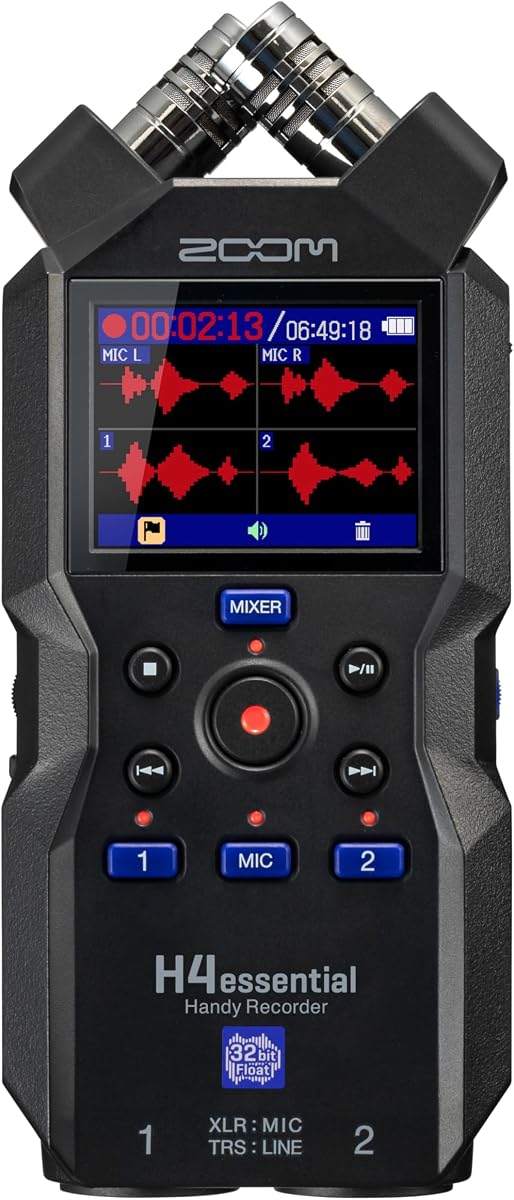
The H4 Essential provides a practical bridge between handheld simplicity and professional interface requirements. It supports four-track recording and includes two XLR/TRS inputs, allowing you to capture interviews or music alongside ambient sound effectively.
We may earn a commission when you buy through this link, at no additional cost to you.
With USB-C connectivity you can stream directly to devices or computers while simultaneously saving backups to an SD card. Spoken menu guidance makes navigation easier for visually impaired users and simplifies the learning curve for creators new to field recording.
Although it lacks timecode synchronization and has a smaller gain range than top-tier models, its balance of features makes it well suited for smaller projects and hybrid workflows. The built-in mics offer decent quality when external mics are not available.
Choose the H4 Essential when you need flexibility across multiple media types without committing to a fully dedicated audio recorder. It is a capable partner for content creators who value convenience and reliable performance.
Saving to both USB and SD card simultaneously gives you immediate backups and protects against data loss during critical shooting sessions.
Spoken menus improve usability for everyone, ensuring quick access to settings without navigating complex visual menus in tight spaces.
We may earn a commission when you buy through this link, at no additional cost to you.
The Zoom F6 delivers professional performance with 32-bit float recording and six XLR inputs, making it ideal for complex productions needing multiple microphones simultaneously. Its timecode I/O ensures frame-accurate sync with video for flawless post-production assembly.
We may earn a commission when you buy through this link, at no additional cost to you.
You can record up to 14 tracks with full production flexibility, whether you are capturing dialogue, ambience, or music together. The ultra-portable rugged design lets you travel light while maintaining reliability in demanding location environments.
While it carries a higher price and requires familiarity with timecode workflows, its versatility justifies the investment for serious filmmakers. It doubles as a USB audio interface, giving you control in any setup without needing extra gear.
For productions where audio quality and synchronization are paramount, the F6 stands out as a top choice. It provides the tools needed to capture pristine sound and sync it perfectly with your visuals.
Frame-accurate sync prevents costly rework in editing, ensuring audio and video align perfectly even after long shooting days.
Using it as a standalone recorder or USB interface allows seamless transitions between location and studio without changing equipment.
We may earn a commission when you buy through this link, at no additional cost to you.
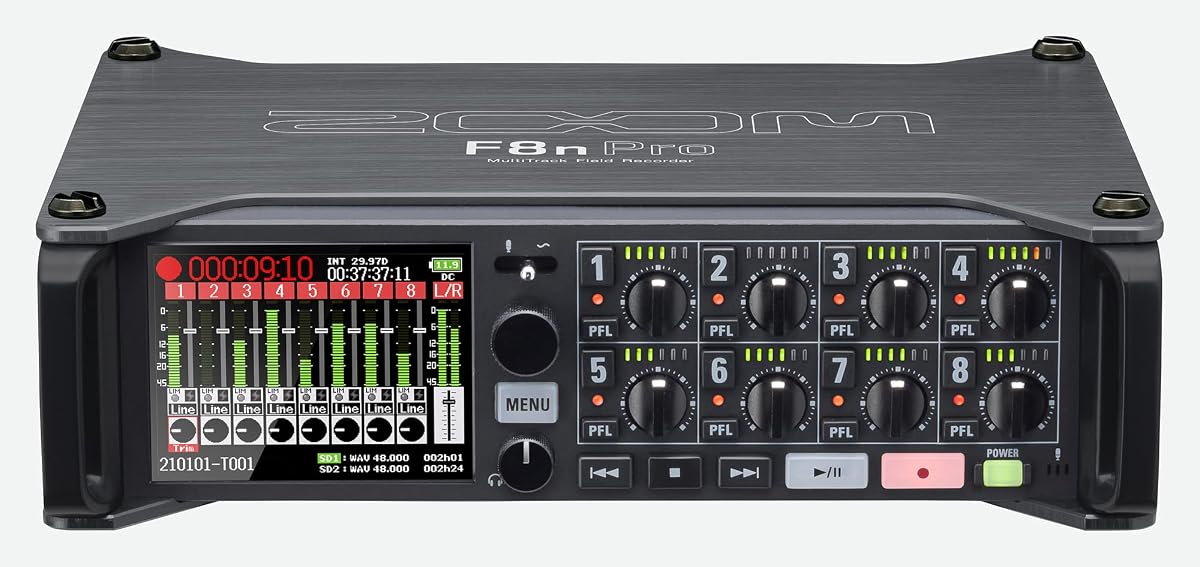
The Zoom F8n Pro represents the pinnacle of field audio capture with eight inputs and ten tracks designed for demanding professional workflows. Its timecode accuracy down to 0.2ppm ensures your audio remains perfectly aligned with picture during editing.
We may earn a commission when you buy through this link, at no additional cost to you.
Dual SD card slots allow redundant recording, safeguarding your takes against card failure. With 75dB gain and -127dBu EIN preamps, it captures both quiet dialogue and dynamic sequences with pristine clarity.
While it is expensive and requires time setup, it offers unmatched flexibility for large sets. You can also use it as an eight-in/ four-out USB interface while recording, giving you a complete production toolkit in one device.
If you need maximum channels and data safety, the F8n Pro is worth the investment. It provides the reliability and precision necessary for high-stakes film and broadcast work.
Saving simultaneously to two SD cards eliminates risk of losing critical takes if one card fails during a shoot.
Recording directly to card while streaming audio to a computer enables seamless live monitoring and control.
We may earn a commission when you buy through this link, at no additional cost to you.
The H1 XLR offers professional-quality 32-bit recording at 96kHz in an accessible package perfect for interviews and everyday tasks. Two XLR/TRS combo inputs let you connect microphones and instruments easily for versatile setups.
We may earn a commission when you buy through this link, at no additional cost to you.
Its OLED waveform display helps you monitor levels at a glance, ensuring clean recordings without constant adjustments. With support for SDXC cards up to 1TB, you have ample space for extended sessions.
While it lacks timecode and is limited to two channels, it delivers impressive clarity for its price. It is an ideal stepping stone for creators who want reliable performance without breaking the bank.
For budget-conscious filmmakers, the H1 XLR balances cost and capability. It captures detailed sound that elevates your projects without the complexity of high-end units.
Visual feedback ensures you never miss a recording level spike, keeping your audio consistent across takes.
Supporting 1TB cards means you can record long interviews or multi-day shoots without changing media.
We may earn a commission when you buy through this link, at no additional cost to you.
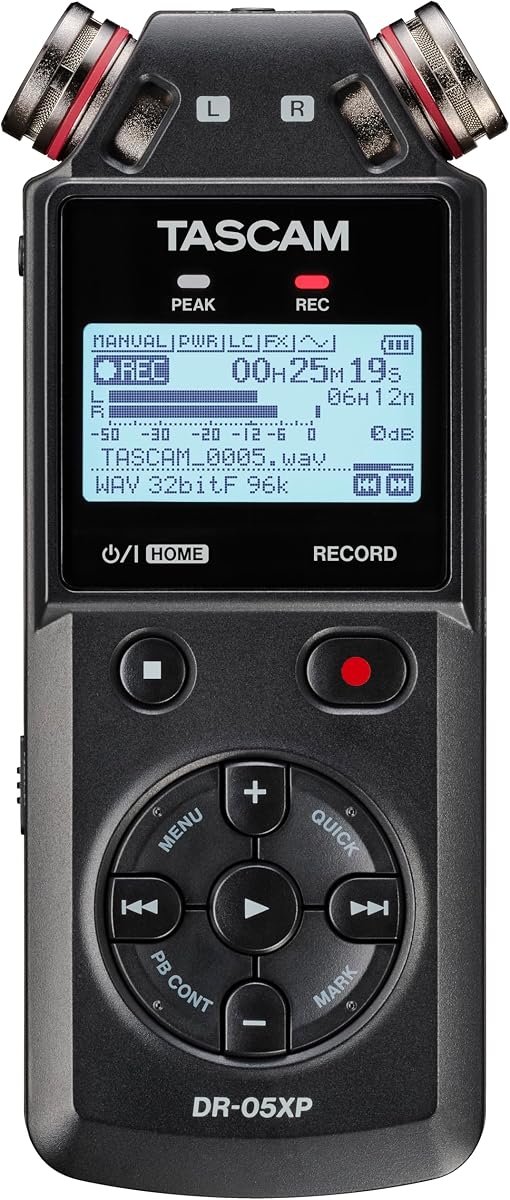
The DR-05XP is a compact solution making it easy to capture pro-quality recordings for music and meetings. Its 32-bit float recording and flexible modes ensure clarity across different environments without clipping.
We may earn a commission when you buy through this link, at no additional cost to you.
Built-in omnidirectional condenser mics handle loud sources up to 125dB SPL effectively. With up to 17.5 hours of battery life, it supports extended shooting sessions without frequent recharging.
Though it lacks external inputs beyond USB-C and has basic features, its portability and durability suit quick captures. It is a reliable companion for capturing spontaneous sound or backup audio on set.
When you need a lightweight recorder for occasional use, the DR-05XP delivers. It offers essential features in a small form factor that fits easily in your camera bag.
Long runtime reduces the need for spare batteries, making it convenient for day-long shoots.
Omnidirectional mics withstand loud noise levels without distortion, ensuring clean capture in busy environments.
We may earn a commission when you buy through this link, at no additional cost to you.
The H5 uses interchangeable input capsules that can be swapped like camera lenses, offering versatile sound capture for different scenarios. It includes a detachable X/Y capsule for reduced handling noise and extended signal capacity.
We may earn a commission when you buy through this link, at no additional cost to you.
You get four-track simultaneous recording and two mic/line inputs with selectable phantom power. The audio safety net protects recordings by capturing a backup track in case of unexpected peaks.
While it lacks modern 32-bit float and uses older technology, its modularity and multitrack capability remain valuable. It is well suited for musicians and filmmakers needing adaptable audio solutions.
Choose the H5 if you need modular flexibility without investing in expensive gear. It offers solid performance and a wide range of compatible capsules to expand your setup.
Changing capsules allows you to optimize for different sound sources without buying separate units.
Backup tracks protect against clipping, ensuring you retain usable audio even when levels spike unexpectedly.
We may earn a commission when you buy through this link, at no additional cost to you.
The DR-10L Pro offers superior personal audio recording with a 32-bit float engine and an included lavalier microphone designed to work seamlessly together. It supports LTC Jam Sync for synchronized multi-device setups.
We may earn a commission when you buy through this link, at no additional cost to you.
Stealthy design makes it ideal for interviews and busy settings. You can control up to five recordings via the app, enabling coordinated audio capture across multiple subjects.
While it is limited to one channel, its precision and ease of use make it great for solo shoots. Support for 512GB cards ensures ample storage without needing frequent swaps.
For personal audio and on-camera dialogue, the DR-10L Pro excels. It provides professional fidelity and synchronization without bulk, making it a practical tool for independent creators.
Managing multiple recorders simultaneously simplifies group interviews and complex setups requiring synchronized audio.
The included mic is tuned for the recorder, ensuring optimal sound quality right out of the box.
We may earn a commission when you buy through this link, at no additional cost to you.
The H1 Essential captures clear stereo audio ideal for videos, reels, and voiceovers. It allows you to record songwriting sessions or live music with detailed sound in the moment.
We may earn a commission when you buy through this link, at no additional cost to you.
You can connect via USB-C for livestreams and remote calls, making it versatile for hybrid content creation. Its simplicity enables quick access when inspiration hits without complex setup.
While it lacks external inputs and XLR connectivity, it delivers polished sound for casual projects. It is perfect for creators who prioritize convenience and clear vocals over advanced features.
For online content and quick captures, the H1 Essential offers reliable quality. It streamlines recording so you can focus on your message rather than technical details.
Using it as a USB microphone enhances livestream audio quality without additional interfaces.
Recording room tone and nature sounds enriches your video production with immersive audio elements.
We may earn a commission when you buy through this link, at no additional cost to you.
The F2 is the smallest wearable recorder with 32-bit float tech, capturing clip-free audio at any volume without gain changes. It includes an omnidirectional lavalier mic with secure accessories for discreet placement.
We may earn a commission when you buy through this link, at no additional cost to you.
With up to 15 hours on two AAA batteries, it supports long-form shoots efficiently. Precision clock ensures perfect sync with video, critical for professional film work.
Though it needs separate microphones and lacks advanced features, its portability makes it great for interviews and on-camera recordings. It is a discreet solution that keeps audio reliable throughout the day.
For interviews and wearable audio needs, the F2 is a smart choice. It provides professional fidelity and synchronization in a compact package that won't distract from your subject.
32-bit float prevents distortion, ensuring clean audio even when subjects speak loudly unexpectedly.
Accurate clocks keep audio and video aligned, reducing editing time and avoiding sync drift.
We may earn a commission when you buy through this link, at no additional cost to you.
Selecting the right recorder depends on your specific workflow needs, budget, and the scale of production. Understanding key factors helps you match a device to your on-set requirements.
Modern recorders with 32-bit float allow you to capture quiet dialogue and loud peaks simultaneously without clipping. This ensures no take is lost to volume spikes and simplifies post-production normalization.
Look for units explicitly stating float capability to guarantee reliable audio under variable conditions.
Consider how many microphones you need to connect at once. Some recorders offer two inputs for solo work while others provide six or more for complex setups.
Ensure connectors match your gear, especially XLR versus combo jacks, to avoid adapter issues on set.
Frame-accurate sync keeps audio perfectly aligned with video in post. This is vital when working with multiple cameras or when sound is recorded separately.
Choose a recorder with timecode I/O if multi-camera workflows are part of your production plan.
Smaller units are easier to transport but may have limited battery life or inputs. Balance size with your need for extended recording without frequent recharging.
Check battery types and capacity to ensure your recorder lasts through long shoots.
High-capacity SD cards allow longer recording sessions without swaps. Redundant dual-slot recording adds a safety layer against card failure.
Verify supported card types and maximum capacity before purchasing to avoid compatibility issues.
Many recorders double as audio interfaces for computers or livestreams. This adds versatility if you need to broadcast or monitor remotely.
Ensure USB-C or USB-A connections meet your device compatibility for seamless integration.
Intuitive controls help you adjust settings quickly in the field. Physical buttons are often preferred over touchscreens in bright or wet conditions.
Test the interface ergonomics if possible to ensure ease of use during stressful shoots.
Rugged construction protects gear during travel and outdoor filming. Shock resistance and weather sealing can make a difference in unpredictable environments.
Prioritize durable materials if you frequently shoot in challenging locations or rough terrain.
Begin by setting input levels and enabling float recording if available. Check battery charge and insert a formatted high-speed SD card before recording starts to avoid interruptions.
During shoots monitor levels visually or through headphones to ensure clarity. If using timecode, sync with your camera before rolling to maintain alignment throughout the scene.
After use remove batteries if the device will sit unused for long periods. Store the recorder in a padded case with silica gel to prevent moisture damage and keep connectors clean.
It captures a massive dynamic range without clipping, letting you normalize audio safely after shooting. This ensures no take is lost due to volume spikes, simplifying post-production.
Timecode is essential when syncing audio from multiple cameras or separate units. For simple interviews or solo shoots, it may be optional but still helpful for organization.
Use high-speed SDXC cards rated for continuous write speeds. Ensure compatibility with your recorder's capacity limits to avoid buffering or recording errors.
Many modern recorders support USB audio interfaces. Check specs to confirm sample rates and connection type before relying on them for streaming or computer recording.
Use high-quality cables, ensure batteries are fresh, and avoid overcrowding USB hubs. Regularly check storage space and format cards correctly to maintain stability.
Wireless mics transmit audio directly to cameras, while field recorders capture it locally for higher fidelity. Using both can offer safety backups and better post-production flexibility.
The Zoom F3 and F6 lead with their balance of portability, dynamic range, and synchronization features. They serve as versatile workhorses for producers who need reliability without excessive complexity.
Prioritize input flexibility and timecode support if you work with multiple cameras or complex audio setups. Budget-conscious creators will find great value in the H1 XLR and F2 for simpler projects.
Always verify current specifications and availability since models evolve quickly. Choosing the right recorder ensures your audio remains crisp and synchronized, making the difference between amateur and professional productions.