
LAFVIN Basic Starter Kit
4.5Editor score
Affordable entry price
Basic component set
Tutorial included
This guide compares the top ESP32 Starter Kits available in October 2026 to help you choose the best option for learning IoT and electronics projects.
Finding the right ESP32 Starter Kit is essential for anyone looking to dive into the world of Internet of Things and embedded systems. These kits provide the necessary hardware and tutorials to get started quickly.
We compared ten top-rated kits based on component variety, tutorial quality, board capabilities, and overall value for money. Our goal is to highlight the best options for beginners and advanced makers.
Each pick below shows what makes it stand out along with detailed pros and cons to guide your decision. Please note that product prices and availability can change frequently over time.
4.5Editor score

4.3Editor score

4.6Editor score
This table provides a side-by-side comparison of all ten kits to help you quickly identify the best fit for your specific needs and skill level.




The ELEGOO ESP-32 Super Starter Kit stands out as a top choice for learners seeking a complete package. With a high rating of 4.3 stars, users appreciate the vast array of modules and components included in the box.
We may earn a commission when you buy through this link, at no additional cost to you.
Its core strength lies in the powerful dual-core ESP-32 board which enables advanced Internet of Things projects. The inclusion of over 35 different modules allows for extensive experimentation without needing extra purchases.
While the price point is higher than basic kits, the quality of the components and the structured tutorial path justify the investment. The online community support adds significant value for troubleshooting complex issues.
This kit is ideal for students and hobbyists who want a reliable foundation in electronics and coding. It provides all the necessary tools to build smart devices and interactive gadgets effectively.
The dual-core processor ensures smooth handling of complex IoT tasks and simultaneous operations.
Beginner-friendly tutorials guide users from basic circuits to advanced applications step by step.
We may earn a commission when you buy through this link, at no additional cost to you.
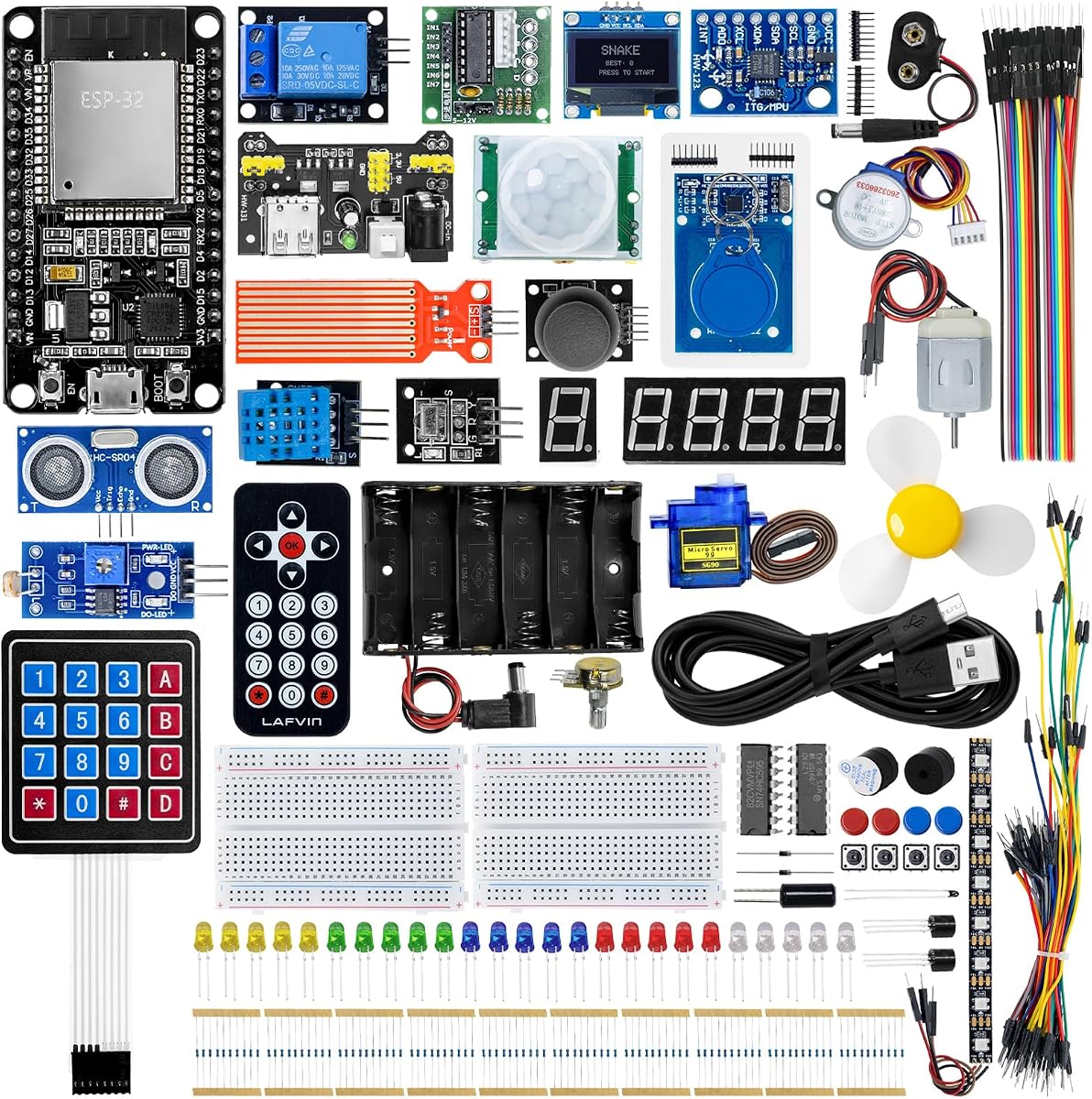
The LAFVIN Basic Starter Kit offers an excellent entry point for those on a tight budget. With a strong rating of 4.5 stars, it proves that you do not need to spend much to start learning electronics.
We may earn a commission when you buy through this link, at no additional cost to you.
This kit focuses on the essentials by providing the ESP32 module and a few key sensors like the DHT11 and OLED display. It is perfect for mastering the fundamentals of programming and hardware interaction.
The main trade-off is the limited variety of components compared to more expensive options. However, for someone just starting out, this constraint can actually help avoid feeling overwhelmed by too many choices.
We recommend this kit for beginners who want to test the waters before committing to a larger investment. It provides a solid start for learning basic IoT concepts and coding skills effectively.
Students and hobbyists can start learning without a significant financial commitment or barrier.
A focused set of components reduces complexity for first-time users exploring electronics.
We may earn a commission when you buy through this link, at no additional cost to you.
The Freenove ESP32 Kit stands out as a premium option for users who want advanced capabilities like camera integration. With a rating of 4.6 stars, it delivers robust performance for complex visual IoT projects.
We may earn a commission when you buy through this link, at no additional cost to you.
Its key advantage is the comprehensive library of over 122 projects that guide users through increasingly complex tasks. The included camera board enables unique applications like video streaming and image recognition.
The large detailed tutorial serves as a complete encyclopedia of electronics knowledge which is incredibly valuable. Some users might find the sheer volume of information daunting at first but it offers long-term utility.
This kit is best suited for makers ready to push the boundaries of what the ESP32 can do. If you need camera functionality and extensive learning resources this is a top-tier choice.
The onboard camera enables image processing and streaming projects not possible with standard boards.
With over 122 projects users have plenty of material to master both hardware and software.
We may earn a commission when you buy through this link, at no additional cost to you.
This kit features the newer ESP32-S3 which offers significant improvements over previous models. It is highly rated at 4.6 stars for its advanced connectivity and processing power suited for demanding applications.
We may earn a commission when you buy through this link, at no additional cost to you.
The inclusion of Bluetooth 5 and USB-OTG makes it versatile for modern device interfacing. Users can build sophisticated smart home systems with better range and faster connection speeds than older kits.
The main consideration is the cost which is higher than most other options on this list. For those who do not need the S3 features this might be unnecessary but for enthusiasts it is a powerhouse.
It is an excellent choice for developers who plan to create commercial or complex prototypes. The future-proof hardware ensures that your projects will remain relevant as technology evolves.
Bluetooth 5 provides better range and stability for wireless communication in projects.
Generous flash and RAM allow for storing more complex code and processing data locally.
We may earn a commission when you buy through this link, at no additional cost to you.
With a perfect 5.0 rating this kit is specifically designed for educational purposes and beginners. It focuses on practical learning experiences that help students understand how microcontrollers and sensors work together.
We may earn a commission when you buy through this link, at no additional cost to you.
The included modules cover essential functions like temperature monitoring and basic inputs which are great for classroom settings. It supports Arduino IDE making it accessible for those familiar with that programming environment.
While it lacks the complexity of premium kits it excels in providing a clear path for initial learning. The simplicity ensures that users can focus on understanding the basics without getting distracted.
We recommend this for schools or home educators looking for a structured learning tool. It strikes a great balance between cost and educational value for starting out in electronics.
The kit structure encourages hands-on exploration and builds foundational skills effectively.
Includes just the right mix of sensors and modules to cover core electronics concepts.
We may earn a commission when you buy through this link, at no additional cost to you.
This version offers a middle ground between basic kits and the ultimate premium package. It includes the camera module which opens up visual projects at a more accessible price point than the ultimate kit.
We may earn a commission when you buy through this link, at no additional cost to you.
With 58 distinct projects users can learn how to integrate camera data into their applications. The detailed tutorials ensure that even beginners can understand how to handle image data effectively.
The component selection is slightly reduced compared to the ultimate kit but still covers most needs. This makes it a great option for those who specifically want camera capabilities without paying for extras.
It is highly recommended for hobbyists interested in smart security or visual feedback projects. The combination of price and capability makes it a standout choice in this specific niche.
Users gain hands-on experience with video feeds and image sensors early in learning.
You get advanced features without the full cost of the premium ultimate package.
We may earn a commission when you buy through this link, at no additional cost to you.
This kit focuses heavily on IoT applications with capabilities for web-based control and monitoring. With a 4.4 rating it is well liked for its ability to build smart home prototypes out of the box.
We may earn a commission when you buy through this link, at no additional cost to you.
The inclusion of RFID and motion sensors allows users to create practical access control and alarm systems. You can monitor sensor data in real-time through a browser which is a key learning feature.
While it does not include a camera its strengths lie in interactive control and sensing. It provides a very practical set of tools for those interested in home automation projects specifically.
It is a strong choice for makers who want to build functional prototypes for home use. The components are selected to demonstrate real-world IoT use cases effectively and efficiently.
Learn how to build web servers on the ESP32 to control devices via smartphone.
RFID and motion modules provide a foundation for security and access control projects.
We may earn a commission when you buy through this link, at no additional cost to you.
This kit is distinguished by including a half-size breadboard which makes prototyping much easier. With a perfect 5.0 rating it is highly trusted for its reliability and ease of use for beginners.
We may earn a commission when you buy through this link, at no additional cost to you.
It comes with a wide range of popular sensors like ultrasonic and motion detectors. The expansion board helps users connect components neatly without needing a soldering iron for every connection.
The online tutorials cover both C and Python which offers flexibility in programming language choice. This versatility makes it a great starting point for those unsure which coding path to take.
We recommend this for learners who want to spend less time wiring and more time coding. The included breadboard and jumpers streamline the setup process significantly for prototyping tasks.
The included breadboard and jumpers reduce setup time and frustration for new users.
Access to a broad range of common sensors ensures you can build diverse projects.
We may earn a commission when you buy through this link, at no additional cost to you.
This kit supports graphical coding alongside Python and C which makes it unique for beginners. With a 4.4 rating it is praised for its structured approach to teaching electronics concepts step by step.
We may earn a commission when you buy through this link, at no additional cost to you.
The lessons are organized to build skills progressively starting from simple circuits to complex IoT apps. This logic flow helps students truly understand the relationships between hardware and code components.
Individual labeling on components prevents confusion during assembly which is a thoughtful design feature. The kit is robust enough for home learning or classroom use due to its comprehensive nature.
It is an excellent option for parents or teachers looking to introduce coding without overwhelming students. The ability to start with drag-and-drop coding lowers the initial barrier to entry significantly.
Supports Scratch Python and C to accommodate various skill levels and preferences.
A clear path through lessons helps students stay focused and build confidence effectively.
We may earn a commission when you buy through this link, at no additional cost to you.
This kit uses modular connectors for sensors which simplifies wiring compared to traditional jumper wires. With a 4.5 rating it is well regarded for its advanced hardware and clean design approach.
We may earn a commission when you buy through this link, at no additional cost to you.
The S3 board with 16MB Flash provides ample memory for large code projects and security features. Native USB support makes connecting to computers easier without extra cables or adapters.
The main challenge is adapting to the proprietary modular system if you plan to use other generic parts later. However for rapid prototyping this system saves significant time during setup.
We recommend this for engineers who value quick setup and reliable connections in their workflow. The hardware quality and features make it a premium option for serious development work.
Standardized cables and ports enable fast setup without messy breadboard wiring.
The ESP32-S3 flagship provides secure boot and plenty of memory for complex tasks.
We may earn a commission when you buy through this link, at no additional cost to you.
Choosing the right kit depends on your goals and experience level. Below are the most important factors to consider before buying.
Look for kits that include a diverse range of sensors and modules to maximize project possibilities. More components mean you can build more types of devices without needing extra purchases.
Aim for a kit with at least 20 to 30 parts to ensure you have enough to experiment.
Clear and detailed tutorials are essential for beginners to understand how to connect and code components. Check if the tutorial is online or printed and whether it includes code examples.
A high quality guide can save hours of frustration when setting up your first project.
The ESP32-S3 board offers newer features like Bluetooth 5 and more memory than the standard ESP32. Decide if you need these advanced capabilities or if the standard version is enough.
Standard ESP32s are usually sufficient for most basic learning projects and IoT applications.
Ensure the kit supports the programming language you want to use such as C++ or Python. Some kits also offer graphical coding options which are great for younger learners.
Arduino IDE compatibility is a standard requirement for most educational kits to ensure ease of use.
High quality components are more reliable and less likely to fail during your projects. Check for reputable brands that provide warranty or support for their hardware.
A well built kit will last longer and make your learning experience smoother overall.
Set a budget based on your needs since kits range from basic entry level to premium. More expensive kits often include more components but basic ones are fine for starting out.
You can upgrade later as you gain skills and need more advanced parts for specific projects.
Consider if you need Wi-Fi and Bluetooth capabilities built-in or add-on modules. Most ESP32 boards have these built-in but range and stability can vary.
Check for antennas or built-in features that ensure stable wireless connections for your projects.
Active online communities help solve problems when you get stuck on a project or code. Brands with good customer support can assist with technical issues or missing parts.
A strong community means you can find help quickly when troubleshooting hardware or code issues.
Start by reading the introduction in your tutorial guide to understand the components provided. Install the Arduino IDE on your computer and add the ESP32 board manager to enable programming.
Connect the board to your computer via USB to upload code. Use the provided wiring diagrams to connect sensors and modules to the correct pins on the board.
Store your components in the provided box or a dry place to prevent damage. Keep connectors clean and handle the board carefully to avoid static discharge that could damage the chip.
Most kits in this guide do not require soldering as they use jumper wires and breadboards for connections. This allows you to prototype quickly without permanent soldering. However advanced kits might suggest soldering for permanent setups.
Yes many of these kits are designed specifically for beginners with step-by-step tutorials. They teach you how to connect components and write code from scratch. You do not need prior experience to start using them.
The ESP32-S3 has more memory and better Bluetooth features compared to the standard ESP32. It supports more complex applications and offers faster processing speed. If you need advanced features the S3 is the better choice.
Most kits in this guide provide tutorials in English or offer online versions that can be translated. Some manufacturers allow you to download PDF manuals in multiple languages if needed for your region.
Yes you can use these kits to build prototypes for commercial purposes. However production versions often require custom hardware designs to reduce costs. These kits are ideal for testing and development stages.
You can find help through the manufacturer support pages and the Arduino community forums. There are many online resources and videos available to troubleshoot code or hardware problems.
The ELEGOO ESP-32 Super Starter Kit leads our list as the best overall choice for most users. It balances component variety with high quality tutorials to support a wide range of learning goals.
For those on a budget the LAFVIN Basic Starter Kit offers an affordable entry point without sacrificing core features. Advanced users may prefer the Freenove options for their extensive project libraries.
Remember to check the latest prices and availability on Amazon before making your final decision. These factors ensure you get the best value for your money at the time of purchase.