
Riiai 0-10V
4.6Editor score
Voltage and current output
Portable design
Rechargeable battery
This guide compares the top ten Amfm Signal Generator models for 2026, evaluating frequency range, modulation types, and build quality to help you choose the
Finding the right signal generator for your electronics projects can be challenging with so many options available. A quality Amfm Signal Generator provides precise frequency control and stable modulation essential for testing radio equipment and circuits effectively.
We analyzed ten top-rated models based on user feedback, technical specifications, and real-world performance. This list covers everything from compact handheld units to advanced dual-channel waveform generators suitable for various applications and budgets.
Each pick includes detailed features, pros and cons, and usage scenarios to help you make an informed decision. Prices and availability change frequently, so verify current details on the product pages before purchasing your next generator.
4.6Editor score

5.0Editor score

5.0Editor score
The following table presents a side-by-side comparison of all ten Amfm Signal Generator models reviewed. Examine their key specifications such as frequency limits, output types, modulation capabilities, and portability to identify the best fit for your specific testing needs.




The UNI-T UTG962E stands out as the premier choice for enthusiasts needing reliable AMFM signal generation. Its 5.0 rating reflects exceptional performance and user satisfaction. This handheld generator delivers 60MHz output with dual channels and comprehensive modulation options.
We may earn a commission when you buy through this link, at no additional cost to you.
Its high 200 MS/s sample rate ensures accurate waveform creation even for complex arbitrary signals. The device includes AM FM and PM modulation allowing precise testing of radio receivers and transmitters. Dual channels enable simultaneous signal comparison or phase testing easily.
While the price point is higher than basic models the versatility justifies the investment for serious users. The compact size makes it portable but it still offers professional grade specifications. Some users may find external synchronization features limited compared to bench units.
Engineers and hobbyists needing a portable yet powerful tool should consider this model highly. It balances performance and size perfectly for field work or lab environments. The included accessories like cables and power adapter make it ready for immediate use.
The device supports AM FM PM and FSK modulation enabling diverse testing scenarios for communication systems.
Despite its mini size the 60MHz frequency and 2 channels provide robust functionality for varied applications.
We may earn a commission when you buy through this link, at no additional cost to you.
The OWON DGE2035 offers a solid mid-range option with strong digital capabilities. Users appreciate the clear 3.6 TFT display and easy PC control features. It delivers reliable 35MHz output suitable for many standard testing applications.
We may earn a commission when you buy through this link, at no additional cost to you.
Its 14-bit resolution ensures clean signal generation with minimal distortion. The 125MSa/s sampling rate supports complex arbitrary waveforms effectively. PC control allows integration into automated test setups for efficient workflows.
While the frequency is lower than top-tier models it covers most educational and repair needs well. The interface is functional but some users find buttons a bit stiff. It remains a cost-effective choice for labs needing dual channels.
Ideal for students and technicians requiring digital precision without extreme RF ranges. The combination of screen clarity and connectivity makes it versatile. Verify compatibility with your PC software before purchasing for remote operation.
Connect via USB to control parameters remotely making it suitable for automated testing sequences.
The 3.6 TFT screen displays real-time waveforms clearly aiding quick parameter adjustments.
We may earn a commission when you buy through this link, at no additional cost to you.
This 6-Band model provides exceptional value for those needing broad RF coverage. Its metal construction ensures durability while low phase noise maintains signal purity. Ideal for maintenance and radio testing tasks requiring stable output.
We may earn a commission when you buy through this link, at no additional cost to you.
The frequency span from 100KHz to 150MHz covers most standard broadcast and comms bands. Modulation options include AM and FM which are sufficient for many legacy systems. The knob and button layout is intuitive for quick access.
It lacks a digital readout which may slow down precise frequency setting for some users. However the robust build and noise performance make it a reliable workhorse. Price point is competitive for the frequency range offered.
Choose this for rugged field use where digital features are less critical. It is perfect for testing older equipment or simple RF circuits. Ensure power requirements are met for consistent performance.
High-class metal construction protects internal components while low phase noise ensures clean signals.
Six ranges allow flexible frequency selection across the 100KHz to 150MHz spectrum easily.
We may earn a commission when you buy through this link, at no additional cost to you.
This generator excels with an extremely wide frequency range up to 4400MHz. It supports single and sweep modes for thorough coverage of bands. The power retention feature saves settings after shutdown for convenience.
We may earn a commission when you buy through this link, at no additional cost to you.
Its output is about 1mw and sine wave contains some noise which limits precision use. Despite this it offers unmatched frequency range at a very low price. Suitable for basic RF tuning and scanning tasks.
Users should expect limited amplitude control and signal purity compared to higher-end units. Power options via mobile charger make it highly portable for remote work. The kit format is simple and direct.
Select this if coverage up to 4GHz is your primary need on a tight budget. It is not recommended for high fidelity audio or precise lab measurements. Use it for frequency checks and basic modulation tests.
Coverage from 35MHz to 4400MHz allows testing of diverse RF equipment and bands.
Powered by mobile charger or USB enabling operation without fixed power sources.
We may earn a commission when you buy through this link, at no additional cost to you.
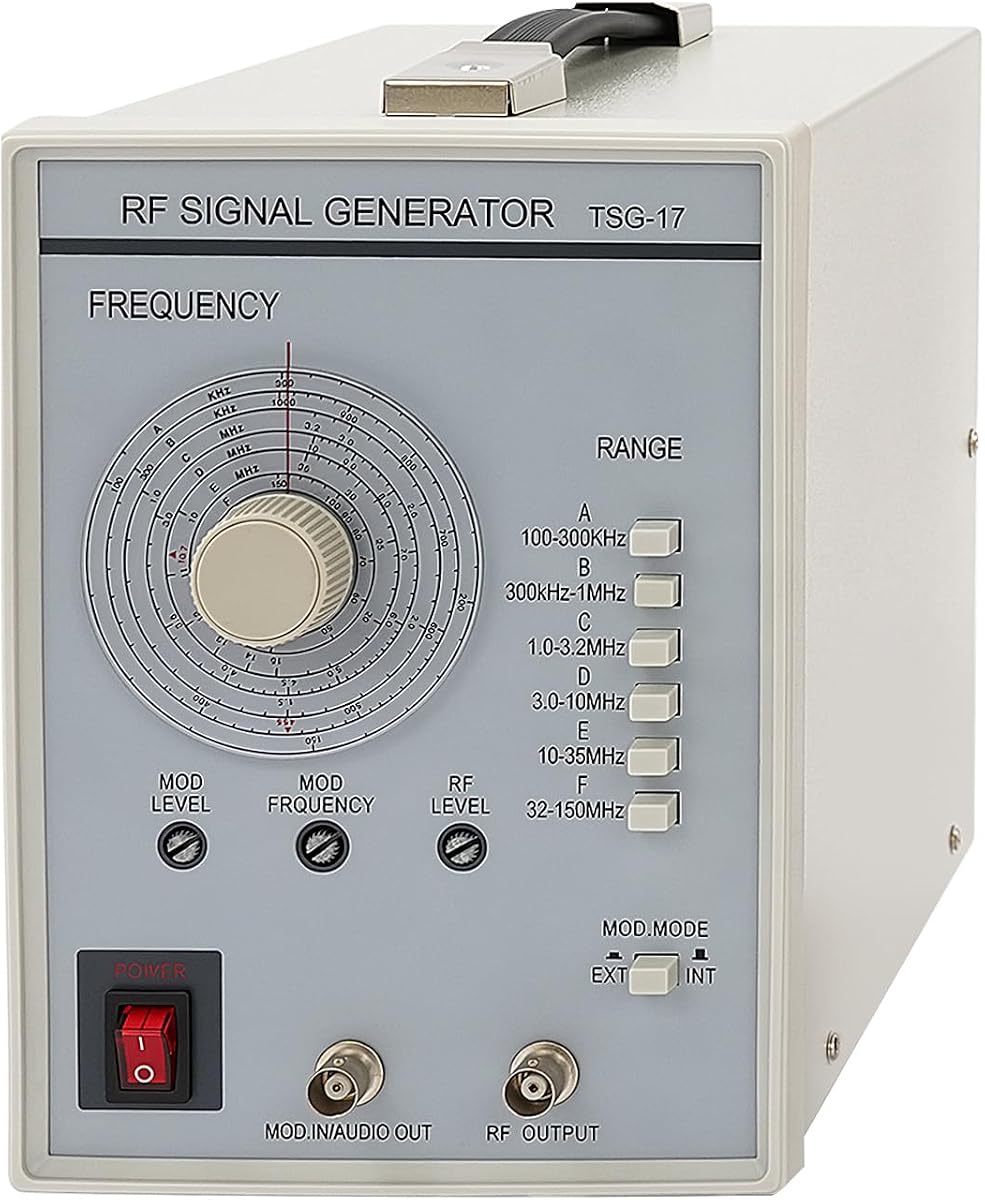
The TSG-17 is designed for household and commercial testing with 110V power input. It covers 100kHz to 150MHz with both sine and AM wave output. External modulation allows signal customization for specific tasks.
We may earn a commission when you buy through this link, at no additional cost to you.
Its accuracy is claimed high but user ratings suggest variability in performance. The fixed AC power limits portability compared to battery units. Still it provides reliable output for stationary bench work.
The modulation input lets you inject external signals for advanced testing scenarios. While the rating is modest it remains a capable tool for specific RF tasks. Ensure you have adequate workspace for the device.
Best for users needing a plug-in solution for consistent testing without battery concerns. It fits well in workshops or homes with stable power access. Check compatibility with your required modulation frequencies.
External modulation input allows custom signals between 50Hz to 20 KHz for diverse testing.
Powered by standard 110V AC ensuring consistent output without battery depletion risks.
We may earn a commission when you buy through this link, at no additional cost to you.
This generator focuses on industrial current and voltage loops with built-in battery. It handles 4-20mA and 0-12V signals for sensor calibration. PWM output adds extra functionality for frequency related testing.
We may earn a commission when you buy through this link, at no additional cost to you.
Its safety features include short circuit protection which protects connected devices. Battery life supports 1 to 5 hours depending on load. Ideal for field maintenance of industrial control systems.
It does not produce RF signals which distinguishes it from pure RF generators. The battery indicator light shows charge status clearly. Adjustments are straightforward via knobs or digital settings.
Select this for process control testing where current and voltage are primary needs. It is not for RF communication work. Ensure charging time and battery health meet your field schedule needs.
Supports 4-20mA and 0-12V outputs allowing versatile industrial loop testing and calibration.
Built-in lithium battery allows hours of operation without access to mains power sources.
We may earn a commission when you buy through this link, at no additional cost to you.
The Riiai 0-10V provides accurate voltage and current signals with great precision. It features a 4-digit display for clear readouts and easy switching. The rechargeable battery ensures portable operation anywhere.
We may earn a commission when you buy through this link, at no additional cost to you.
Its output ranges from -10 to +10V and 0 to 22mA for broad testing. The encoder knob allows fine adjustments which is crucial for calibration. It fits easily in a toolbox for on-site work.
It lacks RF frequency generation so it is best for control signals only. The small form factor makes it very convenient to carry. Safety features like short circuit protection add peace of mind.
This is an excellent budget choice for electronics debugging without RF needs. Use it for PLC or panel testing where voltage current matter. Ensure you charge it fully before extended use.
Encoder knob rotates one circle with 20 pulses for fine precision in voltage and current settings.
Can run on micro USB or external DC power offering flexibility in different environments.
We may earn a commission when you buy through this link, at no additional cost to you.
This analog simulator supports multiple signal types including voltage and current with precision. The real-time curve feature helps visualize signal changes dynamically. It has a large battery for long field use.
We may earn a commission when you buy through this link, at no additional cost to you.
Its color screen displays signals clearly even in low light. Preset values make quick switching between common standards easier. It is designed for detailed PLC and industrial panel testing.
The setup might feel complex for simple tasks but offers deep capabilities. Users value the ability to convert signals and monitor them live. The build quality is solid for daily professional use.
Choose this for advanced industrial diagnostics requiring signal conversion and curve analysis. It is not needed for basic voltage checks. Verify it supports your specific industrial protocol standards.
Real-time curve and TFT color screen allow clear monitoring of signal changes and patterns.
3000mAh battery provides up to 26 hours of working time for long field sessions.
We may earn a commission when you buy through this link, at no additional cost to you.
The DROK generator combines current and voltage output in one compact module. It uses a multi-cycle potentiometer for easy adjustment. Its affordable price makes it accessible for many users.
We may earn a commission when you buy through this link, at no additional cost to you.
Output ranges from 0 to 10V and 4 to 20mA with good stability. The analog nature means it is quick to set without menus. Ideal for basic PLC panel testing and calibration tasks.
Lack of digital display reduces precision compared to coded models. However for many applications its simplicity is a major advantage. The casing is durable and fits easily in tool kits.
Select this if you need a simple robust generator for routine analog checks. It is not for high precision or RF tasks. Ensure the range matches your specific sensor or controller requirements.
Multi-cycle precise potentiometer allows direct and immediate adjustment of voltage and current.
Affordable cost and single module design save space and budget for basic projects.
We may earn a commission when you buy through this link, at no additional cost to you.
The SEESII Dual Channel offers premium performance with fully independent equal channels. It supports 30MHz DDS signals with high sampling and low distortion. The 60 built-in waveforms cover most simulation needs easily.
We may earn a commission when you buy through this link, at no additional cost to you.
Dual channels allow precise phase adjustment and synchronous testing for circuits. Its 14-bit resolution ensures clean output and repeatable results. Comes with full accessories making it ready to use immediately.
The price reflects its high end features and build quality. Some users may find the size larger than portable units but it is justified by performance. Ideal for labs and engineering design work.
Choose this if you need top tier precision and dual channel capabilities. It is perfect for R&D and professional electronics testing. Verify your power and space requirements before purchase.
Two equal-performance channels with adjustable phase difference enable detailed synchronous circuit testing.
High sampling rate and 14-bit resolution produce low distortion signals for accurate testing results.
We may earn a commission when you buy through this link, at no additional cost to you.
Selecting the right generator depends on your specific testing needs, budget, and environment. Consider these factors to find a model that meets your performance expectations.
Ensure the generator covers the frequencies you need to test. Lower cost models may only go up to 35MHz or 60MHz while premium ones exceed 4000MHz.
Choose a range that matches your typical RF or signal requirements to avoid buying unnecessary capacity.
AM FM and PM modulation capabilities are essential for testing communication devices. Verify the unit supports the modulation types your equipment requires.
Look for options like FSK or digital modulation if you need advanced signal testing features.
Dual channel generators allow simultaneous output for comparative testing or complex circuits. Single channel units are sufficient for basic checks but limit flexibility.
Select dual channels if you work with differential signals or need phase comparisons.
Battery powered models offer portability for field work while AC powered units provide consistent output for labs. Consider where you will use the device most often.
Check battery life if portability is a priority to avoid interruptions during critical tests.
The amplitude range determines how strong the signal can be. Some units offer fixed low power while others allow adjustable levels for different loads.
Verify the output range matches your device input requirements to prevent damage or weak signals.
USB and PC control options allow automation and remote adjustments. This can save time in complex test setups requiring frequent parameter changes.
Choose models with connectivity if you plan to integrate the generator into larger test systems.
A clear digital display helps read values accurately in various lighting conditions. Larger TFT screens provide better visualization of waveforms and menus.
Prioritize high-resolution screens if you rely heavily on visual feedback during operation.
Metal or sturdy plastic housings protect the unit from drops and environmental stress. Durability matters for field use where the device may be transported frequently.
Invest in models with robust construction to ensure longevity and reliable performance over time.
Begin by connecting the generator to your test equipment using high-quality cables. Ensure the output impedance matches your load to avoid signal reflection or loss.
Set the frequency and modulation parameters according to your specific test requirements. Double-check values on the display before connecting to sensitive devices to prevent damage.
Store the unit in a dry environment and protect cables from bending or breaking. Regularly check battery levels and clean the screen to maintain optimal performance.
A function generator typically produces basic waveforms like sine and square at lower frequencies. A signal generator often includes modulation and RF capabilities for communication testing.
Yes many models support both AM and FM modulation. Verify the specific unit supports the modulation types you need for your tests.
Match the range to your equipment specifications. If you test standard radios consider units that cover at least 150MHz or higher for flexibility.
If you need to compare signals or test circuits with multiple inputs a dual channel model is worth the cost for flexibility.
Always check the output power before connecting to avoid damaging sensitive components. Use proper grounding and avoid overloading the generator.
Yes they are widely used in labs and classrooms for teaching electronics and RF principles due to their precise signal output.
Battery life varies by model and load. Some units offer 5 hours while others provide up to 26 hours on a single charge.
The UNI-T UTG962E and SEESII models offer top performance for diverse needs. Budget options like Riiai units provide value for specific applications.
Prioritize frequency range and modulation capabilities when selecting a unit. Consider portability and battery life if you work in the field.
Always check current prices and availability on Amazon to secure the best deal for your project needs today.